Bottom line: Hotel shower curtains need three things retail SKUs do not: NFPA 701 or BS 5867 FR compliance, custom sizing for barrier-free bathrooms, and hookless ring headings for housekeeping speed. The hospitality standard is waffle-weave polyester at 170–200 GSM, surviving 50+ commercial laundering cycles per year. Hookless rings hang in under 15 seconds vs 60–90 seconds for grommet-and-hook — meaningful labor savings across a 200-room property. Standard: 12 rings per 71-inch (180cm) panel at 15cm spacing.
Hotel shower curtains carry a different procurement brief than retail SKUs. Housekeeping teams launder them weekly, fire marshals inspect them against NFPA 701 or BS 5867, and barrier-free bathrooms demand custom drops that no off-the-shelf retail size covers. This guide walks through the specifications, compliance paths, and order structure we use for hospitality projects — from 50-room boutique hotels to 600-room international chains.
What Makes a Hotel Shower Curtain Different from Retail
The visual difference is small — most hotel shower curtains look like upscale retail SKUs. The procurement difference is significant. Hotels need three things retail buyers usually don’t ask for: flame retardance certified to a specific test method, sizing that fits non-standard bathrooms (barrier-free showers, deeper tubs, walk-in stalls), and a heading system that housekeeping can hang and replace without specialty tools.
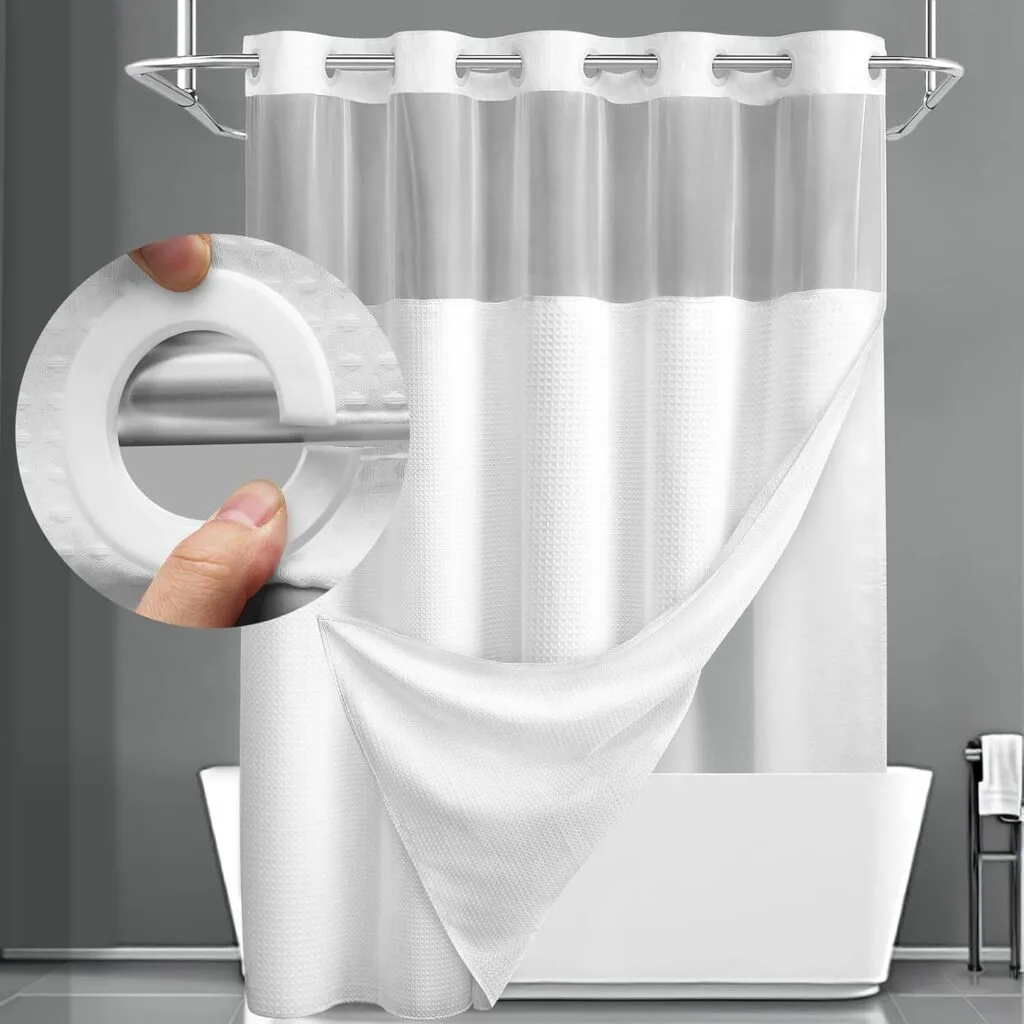
For one 600-room hotel project in Canada under a major international hospitality brand, we supplied waffle-weave polyester shower curtains in solid white at 180 GSM, with reinforced hookless rings and NFPA 701-compliant FR treatment. The brief specified machine-washable panels that hold up through 50+ commercial laundering cycles per year — which ruled out coated fabrics and pointed us toward waffle-weave construction with treatment-based FR.
Fabric and GSM for Hotel Shower Curtains
Three fabric constructions cover the majority of hotel shower curtain orders we produce:
- Waffle-weave polyester (170–200 GSM) — the hospitality standard. Textured surface gives an upscale hand-feel, water sheds without coating, and the fabric stays machine-washable through repeated commercial laundering. Most chain hotel programs spec this.
- Smooth polyester with PU coating (140–180 GSM) — for budget hotel tiers where lower per-piece cost matters more than premium hand-feel. The PU back coating gives full waterproof performance without needing a separate liner.
- Polyester-linen blend (180–220 GSM) — for boutique and design-led hotels where the visual reference is “spa” or “natural fiber” rather than “commercial bathroom.” Higher cost, but accepts custom embroidery and bottom-border embellishments cleanly.
For a deeper breakdown of polyester construction options across all shower curtain categories, see our polyester shower curtain wholesale guide.
Why Hookless Rings Are the Hotel Standard
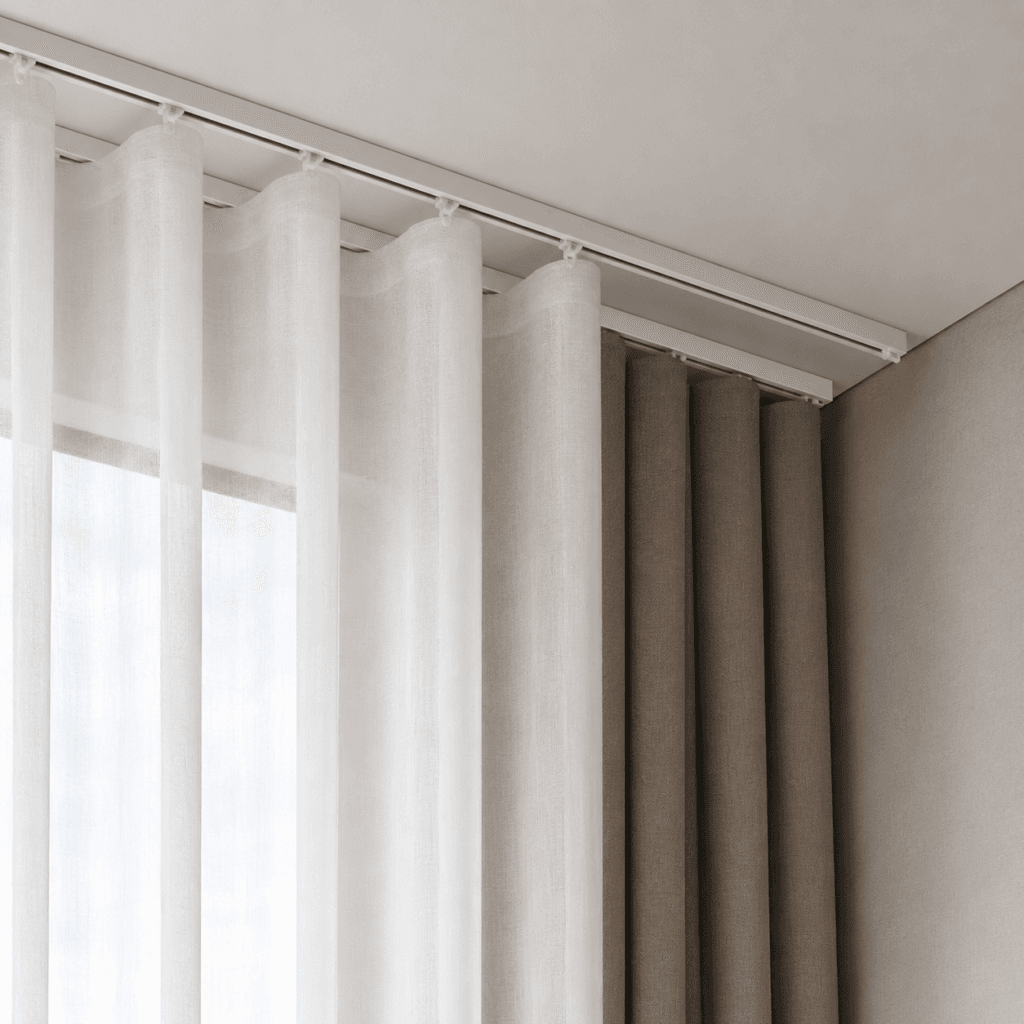
Hookless rings — also called “snap-rings” or “ring-top hookless” — are the dominant heading style for hotel shower curtains, and the reason comes down to housekeeping math. A traditional grommet-and-hook curtain takes a housekeeper 60–90 seconds to rehang after laundering, with the risk of hooks falling into the tub or going missing. A hookless ring-top curtain hangs in under 15 seconds: the housekeeper simply snaps the integrated rings over the rod. Across a 200-room property running weekly laundering, that’s a meaningful labor saving.
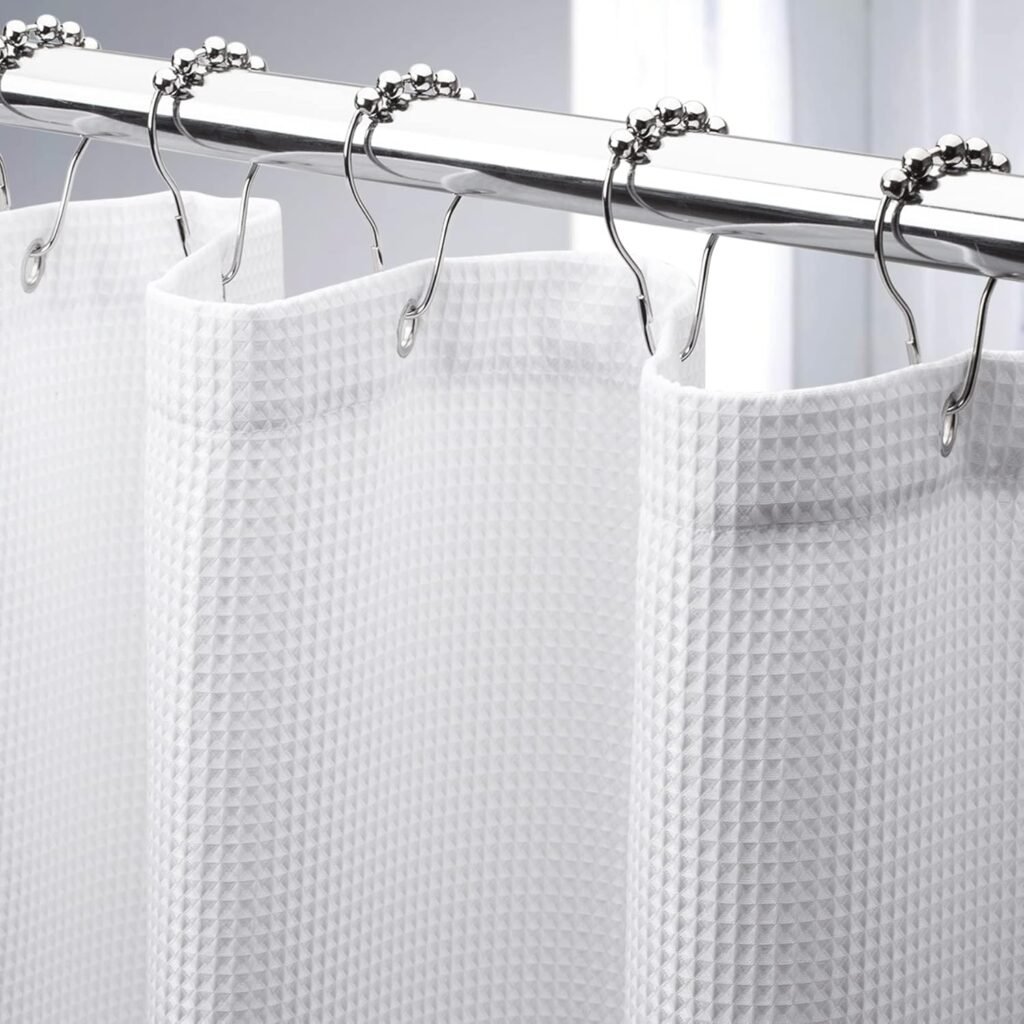
The hookless ring standard for hospitality is 12 rings per curtain on the 71-inch (180 cm) width, spaced approximately 15 cm apart. The rings themselves are typically reinforced plastic or coated metal — we use plastic on chain-hotel programs because it doesn’t scratch chrome rods over time, and metal on boutique and luxury programs where the visual weight matters.
Custom Sizes for Non-Standard Hotel Bathrooms
The retail standard 180 × 180 cm or 72 × 72 inches covers maybe 60% of hotel bathroom configurations. The other 40% need custom dimensions — and getting these specifications right at the order stage avoids on-site fit issues that hotel maintenance teams hate.
| Bathroom Type | Typical Curtain Size | Notes |
|---|---|---|
| Standard tub/shower | 180 × 180 cm (71 × 71 in) | Default for most chain hotel guestrooms |
| Extra-long for deeper tubs | 180 × 200 cm (71 × 79 in) | Common in North American mid-scale chains |
| Walk-in shower stall | 120 × 200 cm (47 × 79 in) | Narrower width, longer drop |
| Barrier-free / ADA bathroom | 200 × 200 cm or 240 × 200 cm | Wider width to fully enclose roll-in showers |
| Curved-rod tub installation | 200 × 200 cm or custom | Wider than rail width to follow the curve |
| Spa / luxury walk-in | Custom up to 300 cm wide | Often paired with weighted hem for drape |
Two specifications matter beyond width × drop: weighted hem (a sewn-in chain or weighted strip along the bottom edge) to keep the curtain from billowing inward during use, and branded labels or barcode tags for hotel inventory tracking — useful when curtains rotate between laundering and storage rooms.
When Hotel Shower Curtains Need Flame Retardancy
Unlike drapery and decorative curtains in public spaces — which are typically required to meet NFPA 701 or equivalent fire standards by code — hotel shower curtains sit in a softer regulatory zone. Most standard guestroom bathrooms in mainstream chain hotels are not specifically required to use FR-certified shower curtains. The flame standard becomes a hard requirement in a smaller set of scenarios:
- Healthcare and assisted living — hospitals, nursing homes, and ER facilities almost always require NFPA 701 shower curtains, both for fire safety and for parallel medical compliance audits.
- High-stringency markets — casino-hotels in Las Vegas, certain New York City properties, and venues in jurisdictions that adopt fire codes more strictly than federal baseline.
- Public-area bathrooms in hotels — spa, fitness center, and pool-deck shower areas often fall under “places of assembly” rules where NFPA 701 applies more clearly than to private guestrooms.
- Brand-mandated specifications — some international hospitality brands include FR shower curtains in their internal procurement standards regardless of local code, as a risk-management baseline across their global portfolio.
When FR is required, two compliance paths exist:
- NFPA 701 (US) — post-treatment FR finish at roughly $0.40–0.80 per piece, or inherently flame-retardant polyester yarn (+$1.20–2.50 per piece) for permanent compliance through the fabric’s life.
- BS 5867 Part 2 Type B/C — UK commercial fire standard, also accepted in much of the Commonwealth. Available on request.
- EN 13773 Class 1 — EU flame propagation standard. Available on request.
- CAN/ULC-S109 — Canadian flame resistance test, often required alongside NFPA 701 for Canadian projects.
For hotels running weekly commercial laundering, post-treatment FR finishes lose effectiveness after 5–10 wash cycles, which means re-treating panels every quarter or accepting that the certification expires before the curtain does. Inherently FR yarn is the correct specification for any contract longer than 6 months — the upfront cost premium pays back quickly versus the re-treatment cycle. Standard hospitality contracts that don’t require FR can use untreated waffle-weave polyester without compliance issues.
Wholesale MOQ, Lead Time, and Project Logistics
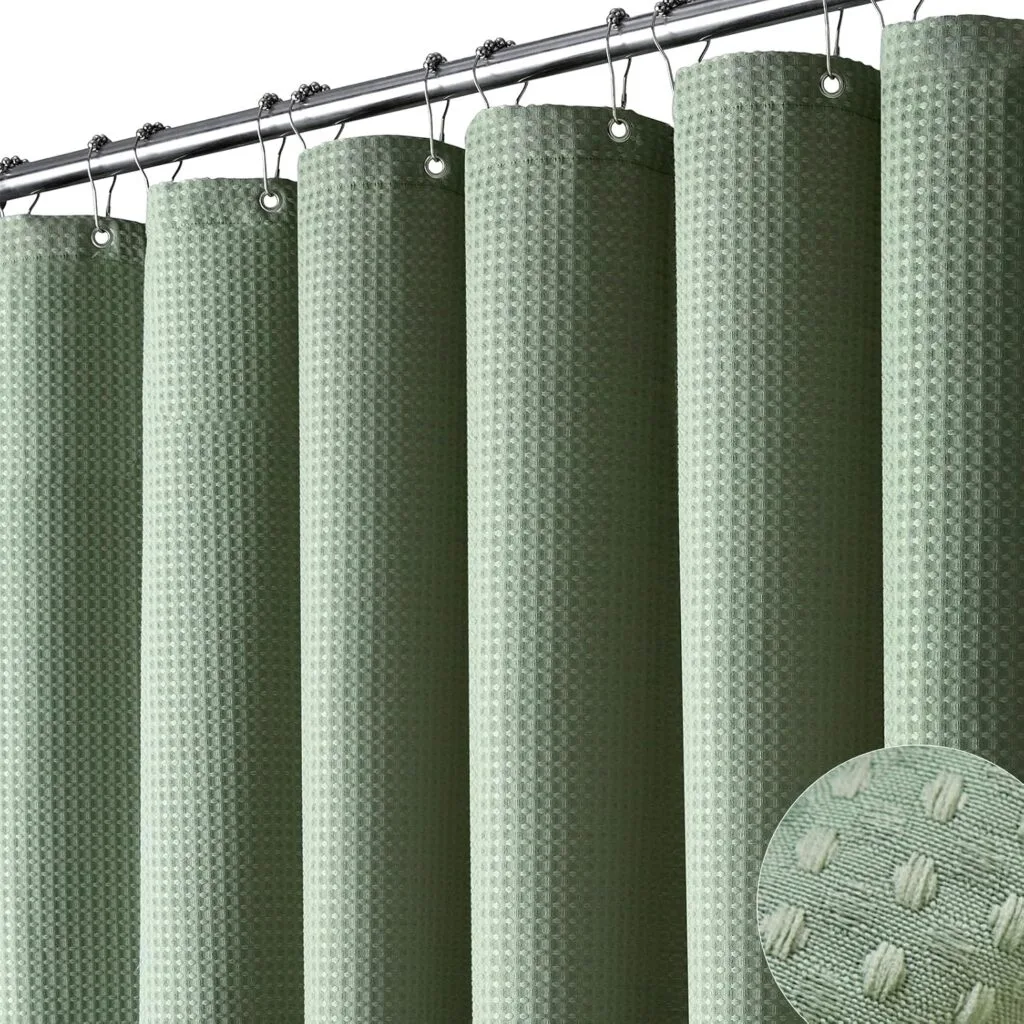
MOQ for in-stock polyester fabrics is 200 pieces per style per color — which covers most boutique-tier projects in a single order. For chain hotel programs running 500–2,000 rooms, custom-woven fabric becomes economic at 800–1,000 meters minimum, with per-piece cost dropping meaningfully on volume. Sample lead time is 3–5 working days excluding shipping; bulk production runs 30+ days from deposit confirmation, with FR-treated orders adding 5–7 days for the finishing step.
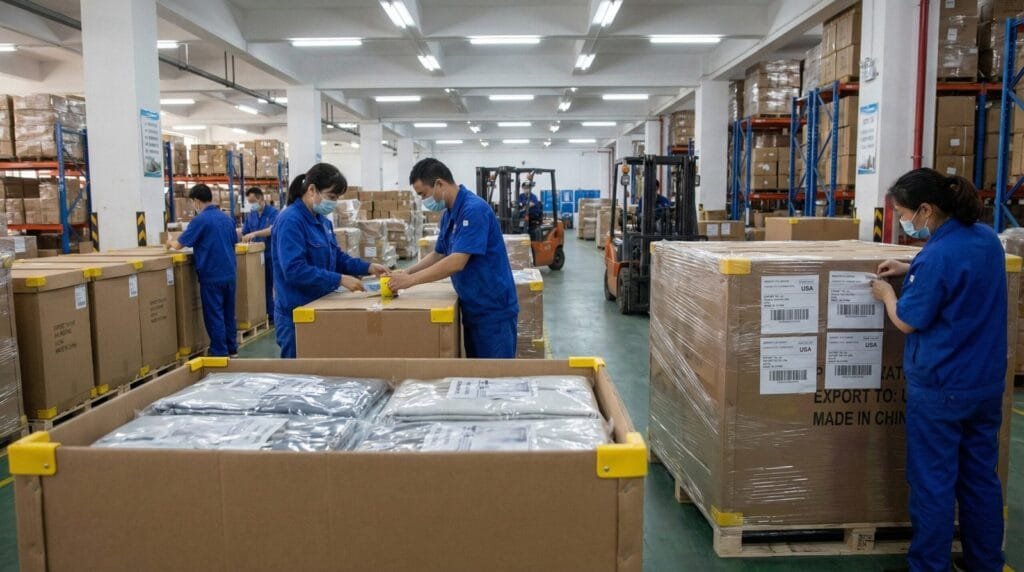
Hotel projects typically ship via 40HQ container — shower curtains pack compactly, so a single container can consolidate the full curtain order for a mid-size property alongside other linens or FF&E items. Payment terms and pricing are confirmed during inquiry based on project size, destination, certification requirements, and delivery timeline.
Sourcing Path: Direct to Factory or Through FF&E Contractor
Hotel shower curtain orders reach us through two channels. Boutique hotels and independent hospitality groups often source direct — the procurement team contacts us, we develop the spec together, we ship to site. Larger chain hotel programs typically run through an FF&E (Furniture, Fixtures & Equipment) contractor or interior design firm, with us as the manufacturing partner. Either channel works; the difference is mostly in how the spec gets finalized and where the invoice flows.
For full OEM and project curtain manufacturing — covering shower curtains alongside drapery, blackout panels, and decorative curtains for a complete guestroom program — see our OEM, ODM and wholesale curtain manufacturing service. For ready-reference shower curtain designs and stock fabric options, browse our shower curtain wholesale catalog.
Bottom Line for Hospitality Procurement
For chain hotel programs, the right spec is usually waffle-weave polyester at 170–200 GSM, hookless ring heading with 12 rings per panel, weighted bottom hem, and inherently FR yarn for any contract over 6 months. For boutique hotels with bespoke design briefs, the fabric and finish open up considerably — embroidered borders, polyester-linen blends, custom Pantone-matched colors. The MOQ structure is the same either way: 200 pieces from in-stock fabric, 800–1,000 meters for custom-woven specifications.
Send a project brief — room count, bathroom configurations, FR standard required, target hand-feel, delivery timeline — to our sourcing desk and we’ll return a specification proposal within one working day.
Last reviewed: 2026-05 · DAIRUI Sourcing Desk