Bottom line: choose the blackout route by separating two questions: what the face fabric must look and feel like, and what the finished window system must do. Woven black yarn builds light control into the cloth; coating or film adds a barrier to the back; a separate lining keeps the decorative face and light-control layer independent. None of these labels, by itself, proves the result for a specific order.
For wholesalers, importers, private-label brands and project buyers, the useful comparison is not “Which construction is always best?” It is “Which construction gives this program the right balance of face appearance, backing, handfeel, drape, care route and verified light-control target?”
Start with the buyer’s decision, not the material name
Before asking for a construction, define the outcome the approval sample must demonstrate. A retail program may place high value on a soft, textile-like hand and an acceptable reverse appearance. A hospitality specification may place more weight on repeatable room conditions and the way the curtain integrates with the track, overlap and returns. A decorative collection may need a face fabric that cannot itself deliver the required light control.
Write the brief in observable terms: face color and texture, acceptable backing appearance, handfeel, drape, finished-panel construction and the light-control target under an agreed evaluation setup. This prevents a trade name such as “blackout” from becoming a substitute for approval evidence.
Four construction routes and when each can make sense
| Route | What it changes | When to shortlist it | What the sample must settle |
|---|---|---|---|
| Woven black yarn | Light-control yarn is integrated into the fabric construction. | When the buyer wants an integrated textile construction and wants to compare handfeel, face and reverse as one fabric. | Actual light control, face and backing appearance, weight, width, drape and color-specific performance. |
| Coating | A coating is applied to the back of the face fabric. | When a backed construction is acceptable and the project needs the coating route evaluated against the required light control. | Backing color and surface, handfeel, flexibility, drape and the result on the exact coated sample. |
| Film or composite layer | A separate barrier is combined with the face fabric. | When an integrated composite construction is acceptable and the buyer is willing to assess the change in body and reverse appearance. | Layer construction, bonding appearance, handfeel, drape, thickness and verified light-control result. |
| Separate lining | The decorative face and functional layer remain separate components in the finished curtain. | When the buyer wants more freedom in the face fabric or wants the light-control layer specified independently. | Lining type and color, attachment, seams, panel weight, heading compatibility, side treatment and whole-system result. |
Woven black yarn: choose it for an integrated fabric decision
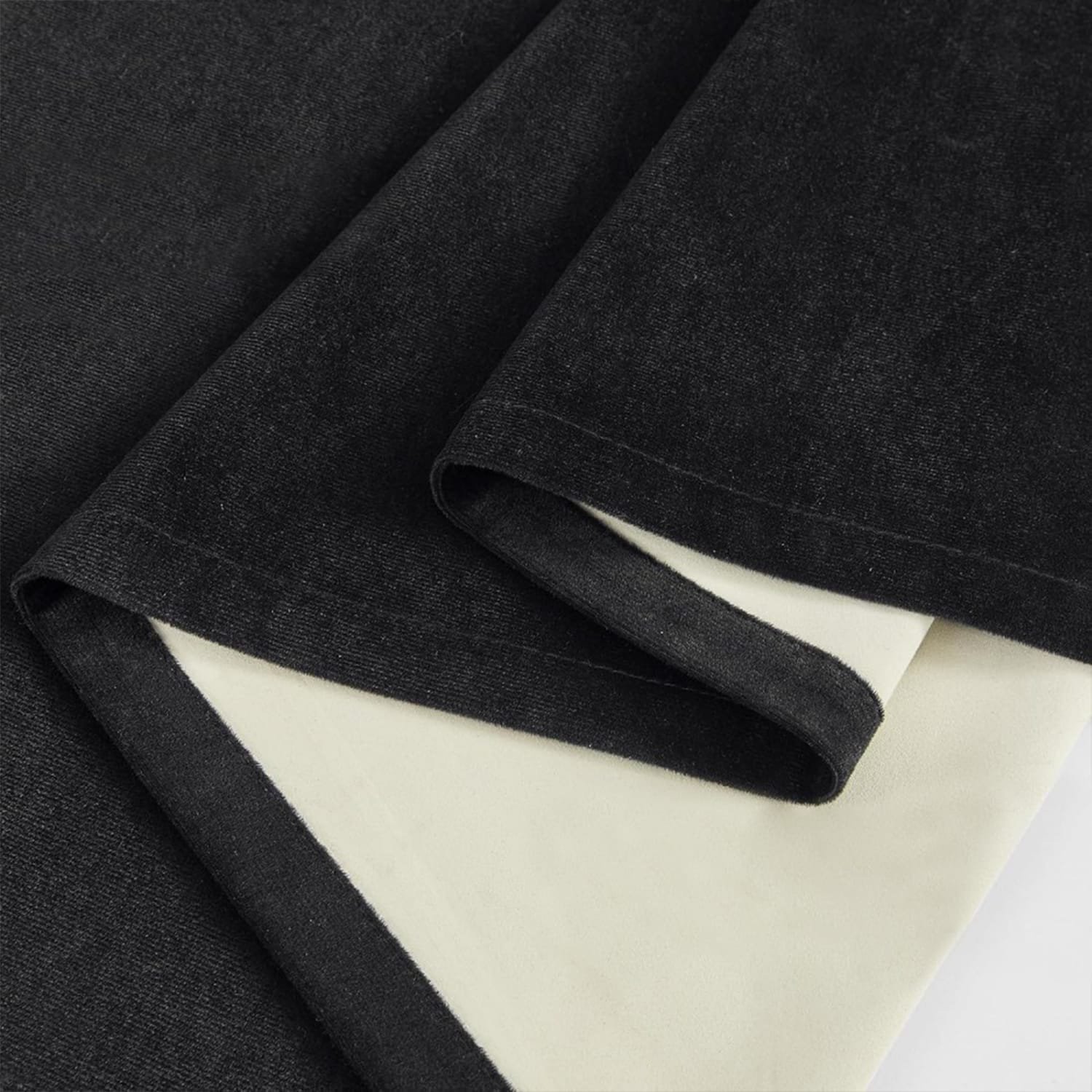
A black-yarn construction can provide strong light control, but the presence of black yarn is not a complete performance specification. The weave, yarn arrangement, color, GSM and other construction details can change the result. It should therefore be approved as a named sample or specification, not as a generic promise attached to every black-yarn fabric.
This route is most useful when the buyer wants to evaluate a single textile layer for face, reverse, handfeel and drape. The sample should be viewed from both sides and in the intended orientation. If the reverse will be visible from outside the building, its color and appearance must be an explicit approval point.
Coating or film: approve the back as carefully as the face
Coating and film are not interchangeable labels. Both add a functional back layer, but they can produce different tactile and construction outcomes. A buyer should request a clear construction description and inspect the actual sample rather than infer performance from a short product name.
Place the sample in the same decision frame as the finished curtain: will the reverse be visible, will the added structure change the expected drape, and will the chosen heading and side treatment work with that body? If a light-control result matters commercially, define how the sample will be evaluated and record the accepted sample identity. Do not transfer a result from another color, base fabric or construction without confirmation.
Separate lining: use it to decouple appearance from function
A separate lining allows the decorative face to be selected for design while the lining carries more of the light-control task. That can be useful for linen-look, jacquard, velvet or other faces whose visual qualities are the priority. The tradeoff is that the buyer is approving a two-layer finished system, not only a fabric swatch.
The approval must cover how the layers are joined or hung, whether the lining is sewn-in or otherwise constructed, how the combined weight affects the heading and drape, and what happens at the panel edges and center overlap. A lining may improve the fabric assembly while the installed window still leaks light around the perimeter.
A practical RFQ and sample checklist
- State the end use: retail range, hotel room, contract project or another defined application.
- Describe the light-control target without assuming a construction automatically proves it.
- Identify face composition, color, texture and acceptable visual variation.
- Ask for the full construction: woven black yarn, coating, film/composite, separate lining or a stated combination.
- Approve the backing color and appearance when it will be visible.
- Record handfeel, drape, GSM and usable width from the exact sample or specification.
- Define the finished construction, including heading, side treatment, overlap and returns where relevant.
- Keep the approved sample code, color, orientation and revision attached to the order record.
Two questions buyers often ask
Does woven black yarn automatically mean complete blackout?
No. It can provide strong light control, but the result depends on the actual fabric construction, sample and evaluation method. Whole-window darkness also depends on installation coverage.
Is a separate lining always better than coating or film?
No. It is a different design route. It can preserve freedom in the decorative face, but it also creates a two-layer finished construction that must be approved for weight, drape, attachment and edge control.
Move from a label to an approved construction
Use the Blackout Curtain category to review construction directions, then use Sample Support to request the exact face/back and finished-construction evidence needed for your program. For a broader project specification, see Solutions Support.
DAIRUI Sourcing Desk
Last reviewed: 2026-08