Bottom line: Importing curtains into the US, UK, EU, Canada, or Australia means clearing three layers of compliance — chemical safety (REACH, CPSIA, Prop 65), labeling (fiber, origin, care, flammability), and flame retardance for hospitality (NFPA 701, EN 13773, BS 5867, AS/NZS 1530.2). Most are buyer-required, not customs-mandatory, but missing them stalls retail listings and FF&E project approvals. This guide maps what each market actually checks, what to request from your factory, and where one report covers two markets.
How to Use This Guide
For every importing market, curtains hit three layers of compliance. Layer 1 is what customs actually enforces — chemical safety, labeling, and tariff classification. Layer 2 is what your retail or platform buyer demands — usually OEKO-TEX, batch test reports, or a recognized social audit. Layer 3 only applies to hospitality and contract projects — flame-retardance certificates accepted by the local fire authority. Skipping Layer 1 means your container sits at port. Skipping Layer 2 means your purchase order gets cancelled. Skipping Layer 3 means your hotel FF&E spec gets rejected on site.
Each country section below uses the same four columns: compliance area, standard or marking, who actually requires it, and what to request from your supplier. Where the answer overlaps across markets (REACH passes for both UK and EU, OEKO-TEX is recognized globally), we flag it so you don’t pay for duplicate testing. For the certificates and test reports we hold, see our certifications reference.
United States
For curtains entering the US, the CPSIA limits on lead and phthalates apply if the product can plausibly reach children — children’s room curtains, blackout panels in nurseries, and similar. California’s Proposition 65 adds a separate disclosure regime for residual chemicals like formaldehyde and certain flame-retardant treatments, and Prop 65 doesn’t care if your buyer is in Texas, because Amazon and Walmart enforce its labeling nationally. Customs itself rarely tests; it is the platforms and big-box procurement teams that ask for proof.
For hospitality projects, NFPA 701 is the dominant flame-retardance standard, with both small-scale and large-scale versions accepted depending on the application. Some state fire marshals require the large-scale version for panels above a certain area.
| Compliance area | Standard / Mark | Required by | What to ask supplier for |
|---|---|---|---|
| Chemical safety (children’s) | CPSIA Sections 101–103 | CPSC + retailers | Third-party lab report for lead and phthalates |
| Disclosure (CA) | Prop 65 | State of California + platforms | SDS / chemical declaration; warning label if applicable |
| Textile labeling | TFPIA + FTC Care Labeling Rule | FTC | Fiber percentages, country of origin, care symbols on permanent label |
| Hospitality FR | NFPA 701 (small + large scale) | State fire marshals + FF&E specs | Pass certificate from an accredited lab, tied to your batch |
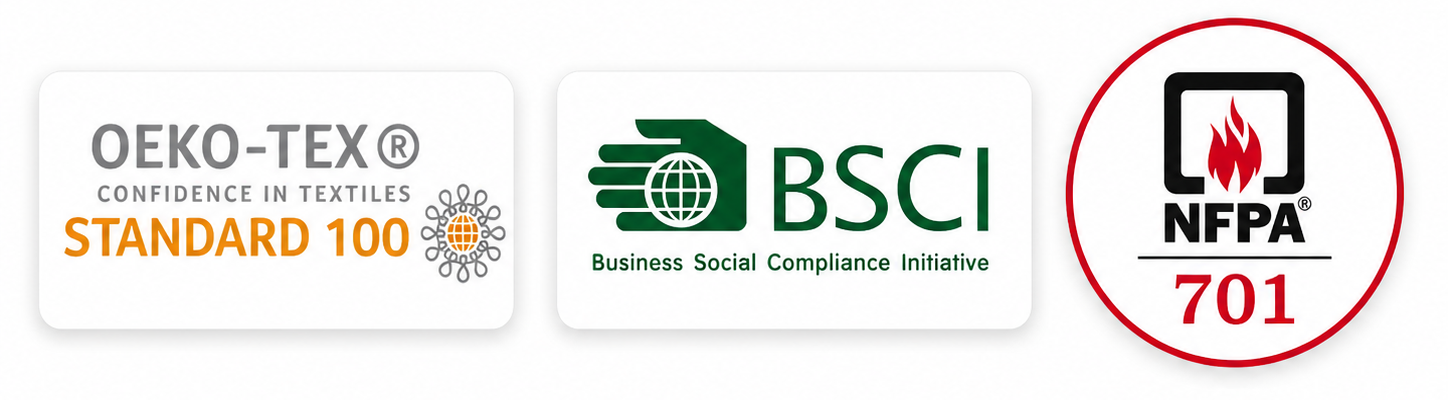
| Voluntary trust | OEKO-TEX Standard 100 | Brands and retailers | OEKO-TEX fabric certificate + test report |
United Kingdom
Post-Brexit the UK runs its own chemical regime (UK REACH), but for textile importers the practical answer is: if your fabric clears EU REACH SVHC limits, it will also clear UK REACH — the Substances of Very High Concern list still tracks the EU version closely. The real UK-specific demand is in hospitality: BS 5867 Part 2 is what hotel groups, NHS estates, and education procurement actually write into specs, with Type B for general public buildings and Type C for higher-risk environments such as care homes.
UK Trading Standards officers can spot-check fiber composition labeling, and incorrect English-language labels are a common reason batches get pulled from department-store deliveries.
| Compliance area | Standard / Mark | Required by | What to ask supplier for |
|---|---|---|---|
| Chemical safety | UK REACH (mirrors EU SVHC) | HSE | SVHC declaration + recent batch test |
| Textile labeling | Textile Products (Labelling and Fibre Composition) Regulations 2012 | Trading Standards | Fiber composition label in English |
| Hospitality FR | BS 5867 Part 2 Type B/C | Hotel groups + public sector procurement | UKAS-accredited lab pass certificate + cure/wash retention data |
| Voluntary trust | OEKO-TEX Standard 100 | Department stores and DTC brands | OEKO-TEX fabric certificate |
European Union
The EU is the most paperwork-heavy market because REACH SVHC, the General Product Safety Regulation (GPSR, effective December 2024), and country-specific fire codes all apply at once. REACH is the non-negotiable layer — your fabric must not contain restricted substances above threshold (azo dyes, certain phthalates, formaldehyde, regulated PFAS). GPSR adds a producer-responsibility layer that means even non-EU suppliers need a designated EU economic operator for online sales into the bloc.
For hospitality, EN 13773 is the harmonized flammability standard with Class 1 as the typical hotel specification. National codes can override or supplement it — Germany may reference DIN 4102 B1, France may cite NF P92-503, and some Nordic countries layer their own requirements.
| Compliance area | Standard / Mark | Required by | What to ask supplier for |
|---|---|---|---|
| Chemical safety | REACH (including SVHC list) | ECHA + customs | SVHC declaration + batch test by accredited lab |
| Product safety | GPSR (since Dec 2024) | Market surveillance authorities | Identifiable producer + EU representative for e-commerce |
| Textile labeling | EU Regulation 1007/2011 | Customs + retailers | Fiber composition in local language(s) |
| Hospitality FR | EN 13773 Class 1 (others by country) | Hotel groups + national fire codes | Notified-body pass certificate + cure retention data |
| Voluntary trust | OEKO-TEX Standard 100 / GOTS for organic | Retailers + DTC brands | Fabric certificate + provenance |
Canada
Canada follows a logic similar to the US but enforced by Health Canada under the Canada Consumer Product Safety Act (CCPSA). Lead and phthalate limits mirror CPSIA for children’s products, and the textile labeling rules under the Textile Labelling Act require bilingual (English and French) fiber and care information, plus a CA dealer identification number. Customs is more likely to flag missing bilingual labels than missing test reports.
For hospitality projects, provincial fire codes typically reference CAN/ULC-S109 for large-scale flame tests and accept NFPA 701 results in many jurisdictions, but the Authority Having Jurisdiction (AHJ) on the specific project is the final word — always confirm before factory cutting begins.
| Compliance area | Standard / Mark | Required by | What to ask supplier for |
|---|---|---|---|
| Chemical safety (children’s) | CCPSA + Phthalates Regulations | Health Canada | Third-party lab report |
| Textile labeling | Textile Labelling Act | Competition Bureau | Bilingual fiber/care label + CA dealer ID number |
| Hospitality FR | CAN/ULC-S109 or accepted NFPA 701 | Provincial fire codes + project AHJ | Pass cert with cure retention; confirm with AHJ |
| Voluntary trust | OEKO-TEX Standard 100 | Major retailers | Fabric certificate |
Australia (and New Zealand)
Australia and New Zealand share most textile compliance. The Australian Consumer Law (administered by the ACCC) provides the consumer baseline, and the Care Labelling Standard (AS/NZS 1957) sets the care-label format. For hospitality and contract work, the key standards are AS/NZS 1530.2 (early-fire-hazard test) and AS 1530.3 (ignitability), and many states reference AS 5637.1 for assessing materials in large buildings under the National Construction Code (NCC).
Both markets enforce voluntary buyer requirements (OEKO-TEX, GECA, sometimes GOTS) more strictly through retail buyers than through customs — Bunnings, Spotlight, and large interior-design groups will ask for them up-front.
| Compliance area | Standard / Mark | Required by | What to ask supplier for |
|---|---|---|---|
| Chemical / consumer safety | Australian Consumer Law | ACCC | SDS + general safety declaration |
| Care labeling | AS/NZS 1957 | ACCC | Care symbol label compliant with AS/NZS |
| Hospitality FR | AS/NZS 1530.2 / 1530.3 / AS 5637.1 | NCC + state regulators | Pass cert from a NATA-accredited lab |
| Voluntary trust | OEKO-TEX / GECA | Major retailers and contract specifiers | Fabric certificate |
Hospitality FR Compliance Cross-Reference
If you supply hotels in more than one country, the most expensive mistake is testing the same fabric four times against four standards. The standards are not interchangeable on paper, but in practice many notified bodies will run a single fabric through multiple protocols at once and issue separate certificates — saving 40–60% on testing cost compared with doing each test in a separate engagement. The cross-reference table below summarizes the dominant hospitality FR standard per market and which lab certifications are usually accepted as proof.
| Market | Primary FR Standard | Typical Hospitality Spec | Notes on Acceptance |
|---|---|---|---|
| US | NFPA 701 | Pass — Small or Large Scale | Most state fire marshals accept; results stay valid as long as fabric and coating are not altered |
| UK | BS 5867 Part 2 | Type B (public) / Type C (higher-risk) | UKAS-accredited lab; demand wash-retention data for laundered curtains |
| EU | EN 13773 | Class 1 (hotels) | National variations may apply (e.g., DIN 4102 B1 in Germany) |
| Canada | CAN/ULC-S109 or NFPA 701 | Accepted varies by province / AHJ | Always confirm with the project’s AHJ before factory cuts |
| Australia / NZ | AS/NZS 1530.2 / AS 5637.1 | Per NCC for buildings above certain class | NATA-accredited lab required for tender submissions |
One detail buyers miss: flame-retardant treatment can wash out if the fabric is post-treated (FR-coated rather than inherently FR). For hotel curtains that go through commercial laundering, request cure-retention test data — a pass certificate that remains valid after a defined number of washes (typically 50). For deeper coverage of FR types and durability, see our guide on fire-retardant and waterproof curtain certifications.
Quick Decision Tree — What to Request from Your Supplier
Before placing a purchase order, hand your supplier a single checklist tied to your import market. Most factories will not volunteer this paperwork unless asked, and last-minute scrambles for certificates are the most common cause of shipment delays.
- Map your end market — single country, EU bloc, or multi-region. This decides which standards stack.
- Identify the channel — children’s retail, hospitality, or DTC. Channel determines which voluntary buyer requirements (CPSIA scope, OEKO-TEX, FR class) actually trigger.
- Request the paperwork bundle: chemical declaration (REACH/CPSIA/CCPSA as applicable), labeling artwork in target languages, FR pass certificate if hospitality, and OEKO-TEX certificate or SGS/Intertek test report.
- Tie certificates to your batch — a generic certificate dated three years ago is a red flag. Ask for a recent test reference number that maps to your production lot.
- Confirm the AHJ for hospitality projects — the local fire authority is the final arbiter; your spec sheet is a starting point, not approval.
For a step-by-step view of how this fits inside a full China sourcing workflow, see our guide to sourcing curtains from China; for hospitality-specific procurement, see the hotel curtain supplier guide. Buyers focused on category fit can browse the blackout and hotel curtain lines for products with documented FR options.
Frequently Asked Questions
Is OEKO-TEX certification mandatory for curtain imports?
No — OEKO-TEX is voluntary in every market covered here. Customs will not stop a shipment for lacking it. The reason it shows up on nearly every buyer’s request list is that major retailers (US department stores, UK high street, EU brands) write OEKO-TEX Standard 100 into their vendor manuals. For project work or private label, treat it as practically required even though legally optional. In practice, compliance is shown with an OEKO-TEX fabric certificate for the material in your order, plus third-party test reports where required to demonstrate compliance.
Does an NFPA 701 pass certificate work for EU or UK hotel projects?
Not officially. EU specifications normally call out EN 13773, and UK specs call out BS 5867 Part 2. That said, many labs can run the same fabric against all three protocols in one engagement and issue separate certificates, which keeps testing cost down. If your project specifier is willing to accept NFPA 701 as evidence in an EU country (some private hotel groups do), get that acceptance in writing from the project’s specifier before relying on it.
What labeling languages do EU curtain imports require?
EU Regulation 1007/2011 requires fiber composition labels in the official language(s) of each member state where the product is sold. In practice for online sales across the bloc, retailers stock multilingual labels or apply local-language stickers in the destination warehouse. Care symbols follow ISO 3758 and are language-neutral.
Are flame-retardant curtains safe to launder commercially?
It depends on whether the FR is post-treated or inherent. Inherently FR fibers (e.g., inherently FR polyester, modacrylic blends) keep their fire performance through repeated commercial laundering — the protection is in the fiber itself. Post-applied FR coatings can degrade after a set number of washes; demand cure-retention test data tied to a wash count (50 cycles is a common benchmark) before the project starts.
Do California’s Prop 65 requirements apply to curtains sold elsewhere in the US?
Prop 65 is a California law, but online platforms (Amazon, Walmart, Wayfair) enforce its disclosure requirements nationally because they cannot reliably segment California buyers. In effect, any curtain listed on a major US e-commerce platform should treat Prop 65 disclosure as nationally applicable, which usually means a brief warning label and supporting chemical data on file.
What documents should accompany every container shipment of curtains?
At minimum: commercial invoice, packing list, bill of lading, fiber composition statement, country-of-origin certificate, and any product safety declarations tied to your end market (chemical safety declaration, FR pass certificates if hospitality). For buyers requesting per-batch QC evidence, include the SGS or Intertek inspection report referencing the production lot. Tying every document to the same lot number is what separates an audit-ready shipment from a scramble.
Bottom Line — What This Means for Your Sourcing
The compliance maps for the US, UK, EU, Canada, and Australia have far more overlap than they first appear: REACH passes carry across to UK markets, OEKO-TEX is recognized across all five, and a single multi-protocol lab engagement can satisfy NFPA 701, EN 13773, and BS 5867 in one trip. The real work is in translating your sales channel into the right paperwork bundle before production starts — not chasing certificates after the container is sealed. Buyers who hand their supplier a one-page checklist tied to the destination market routinely cut testing cost by 30–50% and avoid the most common retail-listing delays.
DAIRUI Sourcing Desk · Last reviewed: 2026-06