The first thing worth clarifying: there are no truly “fireproof” curtains. Fire retardant is the correct industry term — it means the fabric self-extinguishes when the flame source is removed, slowing the spread of fire rather than being immune to it. The word “fireproof” gets used in search because that’s what buyers type, but any supplier using it to describe their product as literally non-combustible is overstating what the chemistry does.
That said, fire retardant curtains are a real and regulated product category with specific performance standards, test methods, and certification requirements. This guide covers what those standards mean in practice, how the two main FR production routes differ, and what to ask a supplier before placing an order.
What Standards Apply to Fire Retardant Curtains?
The applicable standard depends on where the curtains will be installed. The four main standards buyers encounter:
| Standard | Market | Test Method | What It Measures |
|---|---|---|---|
| NFPA 701 | United States, Canada | Small-scale and large-scale flame tests | Fabric must self-extinguish within 2 seconds after flame removal; char length limited |
| EN 13773 Class 1 | European Union | EN ISO 6941 | Limited flame spread, limited afterflame and afterglow time |
| BS 5867 Part 2 Type B/C | United Kingdom, Commonwealth | BS 5438 | Type B: limited flammability; Type C: additional afterglow limits for high-risk applications |
| DIN 4102 B1 | Germany | DIN 4102-1 | Flame retardant (schwer entflammbar) classification |
For most hospitality and commercial projects, your procurement spec will reference one of these standards. If it doesn’t, ask — specifying “fire retardant curtains” without referencing a standard gives a supplier no basis for producing a compliant product, and gives you no basis for rejecting non-compliant goods on arrival.
FR Treatment vs Inherently FR: The Core Production Decision
There are two ways to make a curtain fabric fire retardant. The choice affects cost, durability, and what happens after repeated washing — which matters a great deal for hospitality applications.
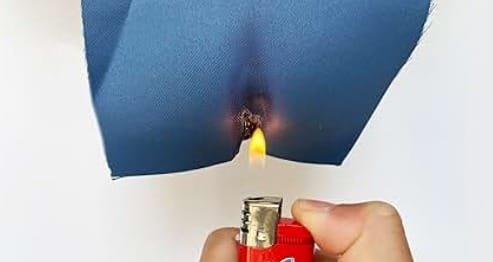
FR Treatment (Post-Finish)
FR treatment is a chemical finish applied to the fabric after weaving and dyeing. The fabric is padded or sprayed with a flame-retardant compound, then cured. It adds approximately $0.40–$0.80 per panel to production cost.
The limitation: FR treatment is not permanent. Treated fabrics lose flame-retardant performance with repeated washing, as the chemical compound washes out of the fibers. For applications where curtains are laundered regularly — hotel guest rooms, healthcare facilities, restaurant dining areas — this is a significant operational consideration.
FR treatment is appropriate for short-cycle applications: trade show displays, pop-up retail environments, event drapery, or any context where curtains are replaced seasonally and commercial washing is not a factor.
Inherently FR Fiber (Permanent)
Inherently FR fabrics use fiber where flame resistance is built into the polymer structure itself — most commonly inherently FR (IFR) polyester, a modified polyester with phosphorus compounds integrated at the molecular level. The fabric doesn’t need a chemical finish because the fiber itself won’t sustain combustion.
The performance holds through repeated commercial washing with no degradation. For long-term hospitality and institutional applications, this is the standard choice despite the higher per-panel cost — approximately $1.20–$2.50 per panel more than standard polyester.
At Dairui, roughly 70% of our hospitality curtain projects specify inherently FR fiber. The pattern we see: buyers who start with FR treatment and experience a laundry-related compliance issue switch to inherently FR on their next order. The cost difference becomes less relevant once you’ve had to replace an entire property’s curtains due to failed re-test.
How FR Certification Works in Practice
Compliance is not a one-time factory claim — it requires third-party test documentation. The standard process:
- Fabric sample submitted to accredited lab (SGS, Intertek, TÜV, Bureau Veritas, BTTG, or Hohenstein depending on the standard)
- Lab conducts the relevant test method against the specified standard
- Test report issued with pass/fail result, test date, fabric description, and lab accreditation reference
- Test report provided to buyer before or with shipment
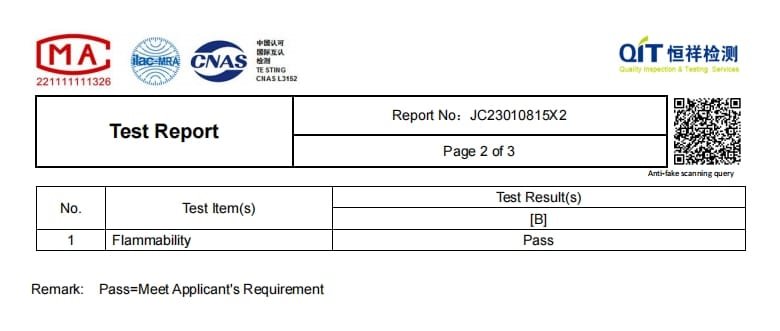
Important: a test report covers the specific fabric tested on a specific date. If the fabric construction or finish changes between test and production, the test report no longer applies. Ask your supplier to confirm that the test report references the exact fabric being produced for your order.
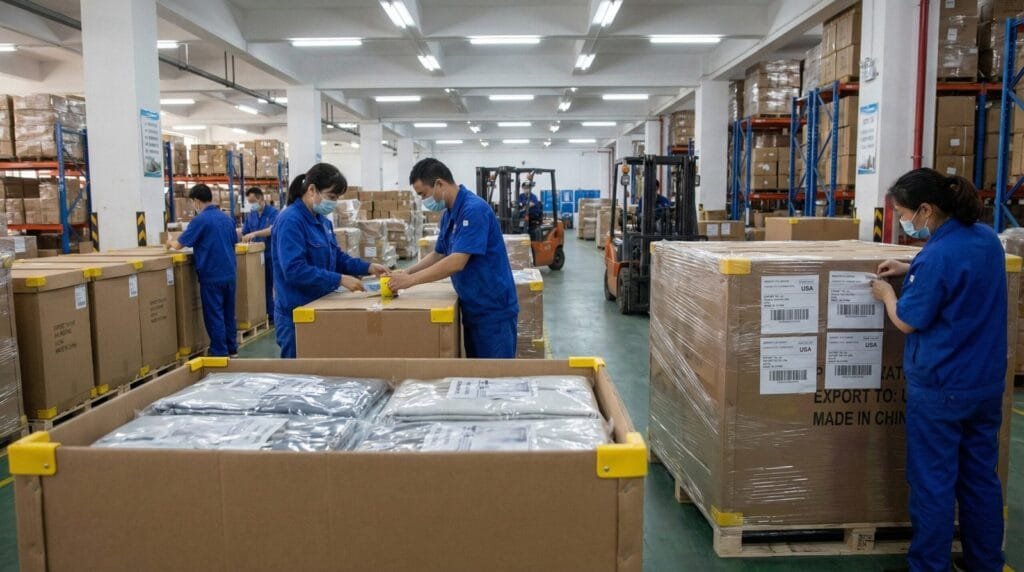
We learned the importance of this documentation in 2019, when a hospitality order arrived at a US hotel and failed the site inspection flame test. The test report on file covered a slightly different fabric weight than what was ultimately produced. The discrepancy was small — 20 GSM — but the inspector rejected the entire shipment. The full order was reproduced at our cost. Since then, we run a pre-shipment burn check on every FR order and cross-reference the production fabric spec against the test report before container loading.
FR + Waterproof: Can You Combine Both Treatments?
Yes — and the combined treatment costs less than buying them separately. A fabric treated for both FR and waterproof performance in a single pass typically adds 15–25% more than a single-treatment finish, not double the cost.
The combined treatment is common for outdoor hospitality applications — poolside cabanas, covered terraces, restaurant pergolas — where both fire code compliance and weather resistance are required. For indoor hotel guest rooms, waterproof treatment is rarely specified alongside FR, as the use case doesn’t require it.
What to Ask a Supplier Before Ordering FR Curtains
Five questions that separate suppliers who understand FR compliance from those who don’t:
- Which standard does your FR comply with — NFPA 701, EN 13773, BS 5867, or DIN 4102? A supplier who says “we have FR certification” without specifying the standard has not answered the question.
- Is this FR treatment or inherently FR fiber? If treatment, ask how many wash cycles the compliance is rated for. If inherently FR, ask for the fiber specification (for example, IFR polyester).
- Can you provide the third-party test report? The report should reference a recognized accredited lab, the specific test method, and a test date within the past few years. A certificate of compliance from the factory itself is not a substitute.
- Does the test report cover the exact fabric being produced for my order? Confirm GSM, construction, and finish match the test reference.
- Do you run a pre-shipment burn check? A pre-shipment check on the production fabric — not just the test sample — is the only way to catch a compliance issue before the goods leave the factory.
What This Means For Your Sourcing
Choosing fire retardant curtains for a commercial or hospitality project is not complicated if you approach it with the right questions. Know which standard your project requires. Decide between FR treatment and inherently FR fiber based on the washing cycle exposure the curtains will face. Request the third-party test report — not a compliance claim — before confirming your order.
The cost difference between a non-FR panel and an inherently FR panel is $1.20–$2.50 per panel. For a 200-room hotel with two panels per room, that’s $480–$1,000 across the entire project. Against the cost of a failed site inspection or a full order replacement, it’s a straightforward calculation.
For more detail on the FR options we produce — including NFPA 701, EN 13773, BS 5867, and DIN 4102 B1 compliance — see our Hotel Curtains page. For FR treatment on blackout or sheer curtains for non-hospitality projects, visit our OEM/ODM Solutions page.
FAQ
What is the difference between NFPA 701 and BS 5867 for hotel curtains?
NFPA 701 is the U.S. and Canadian standard — it requires fabric to self-extinguish within 2 seconds with a char length under 17.8 cm in a large-scale vertical burn test. BS 5867 Part 2 is the UK and Commonwealth standard, with Type B covering limited flame spread and Type C adding requirements for flaming debris. For international hotel chains operating across regions, both certificates are sometimes required on the same fabric. Third-party labs including SGS and Intertek test to both standards on one fabric sample.
How long does fire retardant treatment last on hotel curtains?
Post-treatment FR (chemical finishing applied after weaving) loses effectiveness with repeated commercial washing as the chemical leaches out, so in regularly laundered hotel guestrooms it will not last the life of the curtain. Inherently FR fiber — where flame resistance is built into the polymer chain — is permanent and survives repeated commercial laundering for the life of the fabric. Any hotel contract longer than 12 months should specify inherently FR fiber.
Does fire retardant treatment affect the look or feel of hotel curtains?
Post-treatment FR adds a slight chemical hand-feel on some fabrics — noticeable on thin sheers, less so on heavier blackout fabrics. Inherently FR fiber has no perceptible difference in hand-feel compared to standard polyester of the same weight, because the flame resistance is in the yarn rather than a surface coating. For luxury hotel projects where fabric hand-feel is part of the specification, inherently FR fiber is always preferred.
What does NFPA 701 fire retardant treatment add to the per-panel cost?
Post-treatment FR finishing that meets NFPA 701 adds $0.40–0.80 per panel over standard production cost. Inherently FR fiber adds $1.20–2.50 per panel. Combined FR and waterproof treatment costs 15–25% more than either finish alone. For a 300-room hotel ordering 600 blackout panels, the cost difference between post-treatment and inherently FR runs $480–1,020 — meaningful at scale, but small relative to the cost of replacing non-compliant curtains mid-contract.
Do sheers and lining curtains also need to be fire retardant in hotels?
Requirements vary by jurisdiction and building type. In the U.S. under NFPA 101 Life Safety Code, all window treatments in assembly occupancies (lobbies, conference rooms, restaurants) must be flame retardant. Guestroom requirements depend on the specific jurisdiction and hotel brand standard. In the UK under BS 9999, all curtains in hotel common areas require BS 5867 compliance. The safest approach for international hotel chains: specify FR on all curtains including sheers, and confirm guestroom requirements with the local fire authority having jurisdiction.
What is the MOQ for fire retardant curtains for a hotel project?
MOQ for in-stock FR-treated fabrics is 200 pieces per style per color — sufficient for a boutique hotel or a single floor in a larger property. Projects requiring custom-woven inherently FR fabric have a minimum of 800–1,000 meters for the fabric run. For chain hotel programs above 500 rooms, custom fabric MOQ is typically met within a single property order. Sample lead time is 3–5 working days; bulk production runs 30+ days plus 5–7 days for FR finishing.
Last reviewed: 2026-05 — DAIRUI Editorial Team
Related reading
- Fire-Retardant and Waterproof Curtains: What Certifications Matter
- FR-Treated vs Inherently Flame-Retardant Curtains: Durability, Washing & Which to Spec
- Hotel Curtain Supplier Guide: Sourcing Hospitality Drapery That Passes Inspection (2026)
Sourcing for a live hospitality or commercial project? Explore Dairui’s flame retardant curtain manufacturing and supply options.