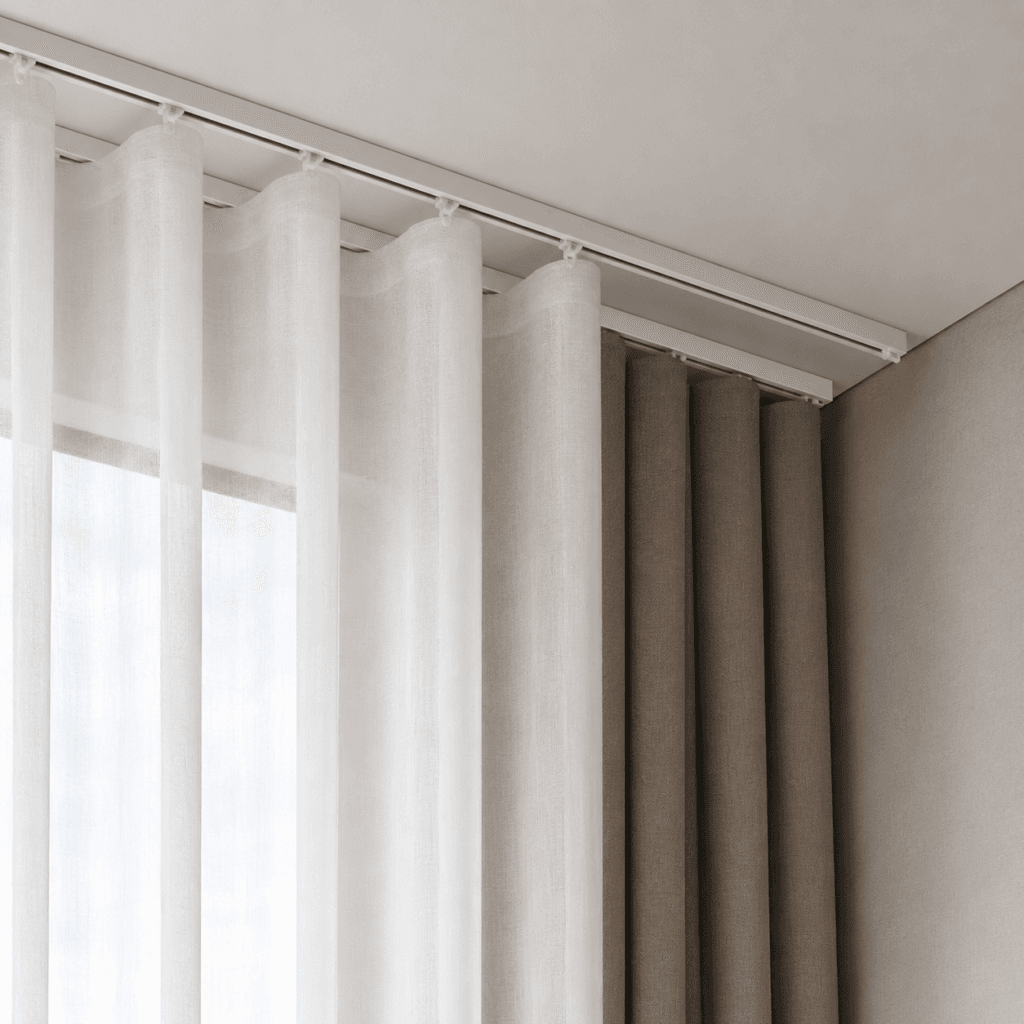
Bottom line: Ripplefold and S-Fold are not interchangeable. Ripplefold uses 8cm carrier spacing and 12.5cm header tape — softer open wave, dominant in North America (Hunter Douglas, Orion, Silent Gliss NA). S-Fold uses 6cm spacing and 10.7cm header tape — tighter structured wave, dominant in Europe and Australia. The carrier-and-track systems are physically incompatible: spec the heading from the installed track, not the other way around. Both require industrial heat-setting to lock fold memory through shipping and washing.
Ripplefold and S-Fold are both wave-style curtain headings. They look similar on the rail and use the same basic principle — evenly spaced carriers create consistent vertical folds across the panel. But they’re not interchangeable. The carrier spacing is different, the track hardware is different, and the markets that buy them are different.
If you’re sourcing curtains for a North American project, a European retail brand, or an Australian hospitality supplier, getting this choice wrong means ordering the wrong heading for your client’s track system. This guide covers the practical differences — from production specs to market fit to what buyers actually ask us about.
What’s the Structural Difference Between Ripplefold and S-Fold?
Both headings use a woven header tape sewn across the top of the panel, with plastic carriers clipped at regular intervals. The carriers hook onto a dedicated track, and the spacing between carriers determines the width and rhythm of each fold.
The key difference is that spacing:
| Spec | Ripplefold | S-Fold |
|---|---|---|
| Carrier spacing | 8 cm | 6 cm |
| Header tape width | 12.5 cm | 10.7 cm |
| Fold rhythm | Wider, more open wave | Tighter, more compressed wave |
| Track system | Ripplefold-specific track | S-Fold-specific track |
| Heat-setting required | Yes | Yes |
| Primary market | North America | Europe, Australia |
The wider carrier spacing on Ripplefold creates a softer, more open fold — the kind that reads well in North American residential and hospitality photography. The tighter S-Fold spacing produces a crisper, more structured wave that aligns with European and Australian interior design conventions.
Track Compatibility: Why This Decision Gets Made Before the Curtain
This is the part most buyers learn the hard way. Ripplefold carriers and S-Fold carriers are not compatible with each other’s tracks. A panel made for a Ripplefold system will not clip correctly onto an S-Fold track, and vice versa.
If your client already has tracks installed — in a hotel room, a showroom, or a residential project — you need to confirm which system those tracks are built for before specifying the heading. The curtain heading is determined by the track, not the other way around.
In North America, the dominant track manufacturers (Hunter Douglas, Orion, Silent Gliss North America) use Ripplefold-spec carrier spacing as their standard. In Europe and Australia, the standard shifted toward S-Fold spacing — tighter folds, different clip geometry.
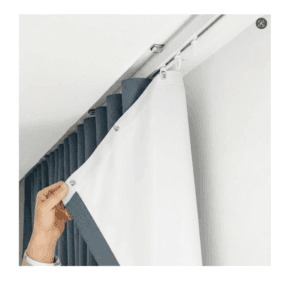
If the hardware is still open on your side, Dairui supplies wholesale curtain tracks with Ripplefold- and S-Fold-spec carriers on the same order as the curtains, so carrier spacing, heading, and fullness are specified together instead of sourced from two suppliers who never compare notes.
Heat-Setting: What Both Headings Require
Both Ripplefold and S-Fold panels require heat-setting to hold their wave shape. Without it, the folds flatten during shipping and storage, and the panel arrives looking like a straight drape with random creases rather than a structured wave.
Heat-setting is an industrial process: the finished panel is loaded onto a frame, the carriers are spaced at the correct interval, and the panel is exposed to controlled heat until the fabric locks into its fold memory. The result is a panel that returns to its wave shape even after being compressed for shipping.
At Dairui, Ripplefold and S-Fold panels run on the same production line — both headings use the same heat-setting equipment, with the carrier jig adjusted for the respective spacing. This is worth knowing when comparing quotes: a factory that doesn’t heat-set is skipping a step, not offering a discount.
One distinction worth noting: Wave Top heading — sometimes confused with S-Fold because of the similar fold appearance — does not require heat-setting and runs on a completely separate production line. Wave Top uses a nylon tape sewn directly to the fabric with no carriers, and hangs on a standard rod or track without specialist hardware. It’s a different product entirely.

Market Fit: Which Heading for Which Region?
The short version: if your buyer is in North America, specify Ripplefold. If they’re in Europe or Australia, specify S-Fold. This isn’t a style preference — it’s a hardware standard that’s driven by what track systems are dominant in each market.
The longer version involves a few nuances buyers encounter in practice:
- Hospitality projects in North America almost universally specify Ripplefold, particularly for hotel guest rooms where Hunter Douglas or equivalent track systems are pre-installed during fit-out. A 600-room hotel project we delivered to a US hospitality chain specified Ripplefold across all room types — floor-to-ceiling, ceiling-mounted track, paired with a sheer S-Fold inner layer specified by their European FF&E design team. Two heading systems in one project is not unusual for international chains.
- Australian residential DTC brands predominantly source S-Fold, with a growing segment requesting Wave Top for mid-range price points where specialist track hardware isn’t assumed. Canadian buyers split between the two depending on whether their end customers are in architect-specified residential (more likely S-Fold) or standard retail (more likely Ripplefold).
- UK and European contract buyers default to S-Fold for wave heading. Pencil pleat remains more common in UK residential retail, but for hospitality and commercial, S-Fold is the standard wave option.
Both headings are staples in hospitality projects – browse our hotel curtains range to see ripplefold and s-fold panels specified for real properties.
Does One Cost More Than the Other?
Not meaningfully. Both headings use the same header tape construction, the same carrier hardware, and the same heat-setting process. The price difference between a Ripplefold panel and an S-Fold panel of identical fabric and dimensions is negligible — usually within $0.10–0.20 per panel depending on carrier sourcing.
What actually drives price is fabric weight, GSM, lining (blackout backing or not), and order volume. A 280 GSM blackout Ripplefold panel costs more than a 120 GSM unlined S-Fold panel — but that’s the fabric cost, not the heading cost.
The one scenario where heading affects cost more directly: very small trial orders where the carrier jig setup adds a fixed cost across fewer panels. At 50–100 panels, the setup cost per panel is more visible. At 200+ panels, it’s absorbed into the per-unit price without any meaningful difference between the two headings.

Production Lead Time: Any Difference?
No — both headings run on the same production line at Dairui, with the same bulk lead time of 30+ days from deposit confirmation. Heat-setting is included in that timeline for both. Samples for either heading take 3–5 working days.
The only lead time consideration specific to heading type is carrier availability. Both Ripplefold and S-Fold carriers are stocked components at our facility. If you’re specifying an unusually high panel count with non-standard carrier color or clip geometry, confirm availability during inquiry.
How to Specify When Placing an Order
When you’re ready to order, specify the following to avoid heading mismatches:
- Heading type: Ripplefold or S-Fold (not just “wave heading” — both are wave headings)
- Carrier spacing: Confirm 8 cm (Ripplefold) or 6 cm (S-Fold) matches your track system
- Track manufacturer or reference: If known, share it — we can confirm compatibility
- Fullness ratio: Standard for both is approximately 1.5x fabric to track width. Some projects specify 2x for a fuller wave — confirm before cutting
- Return panels: If your project requires side returns (panels that wrap around the track end for blackout edge coverage), specify panel dimensions including the return allowance
For projects where the track system hasn’t been specified yet — particularly new-build hospitality or residential — we can advise on which track manufacturers are standard in your target market and which heading to specify accordingly.
Not sure which heading your track takes?
Send your track model or a photo of the carrier. We confirm 8 cm / 6 cm compatibility and ship samples of both headings in 3–5 working days.
Request samples & a track compatibility check
OEM, ODM & Wholesale Curtain Manufacturing
— Both headings from the same fabric base. MOQ 200 pieces per style and colour; trial orders from 50–100 pieces.
What This Means For Your Sourcing
Ripplefold and S-Fold are market standards, not style choices. The decision is almost always made by the track system already on-site or being specified by the designer or FF&E team — your job is to match it correctly.
If you’re building a DTC curtain brand and your customers are in North America, Ripplefold is the default wave heading to stock. If you’re supplying Australian or European residential or hospitality buyers, S-Fold is the standard. For mixed-market wholesale, carrying both heading types from the same fabric base is straightforward — same production line, same heat-setting process, just different carrier spacing.
To discuss a specific project or request samples of either heading, visit our OEM/ODM Solutions page. For a full overview of all eight heading styles we produce — including Wave Top, pinch pleat, and grommet — see our Complete Guide to Curtain Heading Styles.
FAQ
Can Ripplefold carriers fit on an S-Fold track?
No. Ripplefold and S-Fold carriers have different clip geometry and are designed for their respective track systems. They are not interchangeable. Always confirm which track system your project uses before specifying the heading.
Is Wave Top the same as S-Fold?
No. Wave Top uses a nylon tape sewn directly to the fabric with no carriers — it hangs on a standard curtain rod or track without specialist hardware and does not require heat-setting. S-Fold uses a header tape with carriers clipped onto a dedicated S-Fold track and requires heat-setting. They produce a similar visual wave effect but are structurally different products on different production lines. Our wave top curtains guide covers the differences in detail.
Which heading is better for hotel projects?
Depends on the market. North American hotel projects typically specify Ripplefold, as Hunter Douglas and equivalent track systems are standard in US and Canadian hospitality fit-outs. European and Australian hotel projects typically specify S-Fold. International chain hotels may specify both in the same property depending on their FF&E designer’s regional standard.
Does Dairui produce both Ripplefold and S-Fold?
Yes. Both headings run on the same production line with the same heat-setting equipment, with the carrier jig adjusted for each heading’s spacing. Bulk lead time is 30+ days from deposit for both. Samples take 3–5 working days.
What fullness ratio should I specify for wave headings?
Standard fullness for both Ripplefold and S-Fold is approximately 1.5x fabric to finished track width. Some projects specify 2x for a fuller, denser wave — particularly in hospitality where a more substantial drape is preferred. Confirm your required fullness ratio when placing your order, as it affects fabric consumption and per-panel cost.
Ripplefold, S-Fold, wave fold, S-wave, memory fold — are these different products?
No — they are regional names for the same two heading families. In North America the snap-carrier version is sold as Ripplefold (often written ripple fold); Australia and New Zealand call the glider-tape version S-Fold; UK and European suppliers usually say wave fold, wave heading, or S-wave; and in Singapore and Malaysia the same look is often quoted as memory fold, after the heat-set “memory” that holds the wave shape. When comparing quotes across markets, ignore the label and confirm three numbers instead: carrier or glider spacing (8cm vs 6cm), header tape width, and fullness ratio — those determine whether your panels actually fit the track.
Last reviewed: 2026-07 — DAIRUI Editorial Team
Related heading styles: compare tab top curtain construction, grommet vs pinch pleat headers.