Bottom line: This glossary defines 70+ terms that appear in curtain quotations, spec sheets, and inspection reports — from GSM and blackout constructions to AQL 2.5, FOB vs DDP, and MOQ. Each entry is a short, plain-English definition; where a term deserves a deep dive, we link to the full guide. Bookmark it before you read your next proforma invoice.
If you are a retailer, e-commerce brand, or designer buying curtains from a factory for the first time, the vocabulary is half the battle. Suppliers quote in GSM and denier, inspection companies talk in AQL, and freight forwarders assume you know your FOB from your DDP. This page collects the terms we explain most often to new wholesale buyers, grouped into six sections:
- Fabric & Construction
- Light Control & Performance
- Headings & Hardware
- Manufacturing & Customization
- Quality Control & Compliance
- Trade & Logistics
Fabric & Construction Terms

GSM (grams per square meter) — The standard weight measure for curtain fabric. Sheers typically run 60–90 GSM, standard decorative fabrics 120–160 GSM, and blackout constructions 180–400 GSM. Weight drives drape, opacity, and freight cost — see our full curtain fabric GSM guide.
Denier (D) — The thickness of an individual yarn filament. Higher denier means a thicker, more durable yarn; polyester curtain yarns are commonly quoted as 75D, 150D, or 300D.
Warp and weft — The lengthwise (warp) and crosswise (weft) yarns of a woven fabric. Density in each direction determines how tight — and how opaque — the cloth is.
Jacquard — Fabric whose pattern is woven directly into the cloth on a jacquard loom rather than printed on the surface. The design cannot wash off or fade the way a print can.
Voile — A lightweight, semi-transparent plain-weave fabric; the classic base cloth for sheer curtains.
Sheer — Any translucent curtain fabric — voile, gauze, net — that filters daylight while keeping daytime privacy. Usually 60–90 GSM.
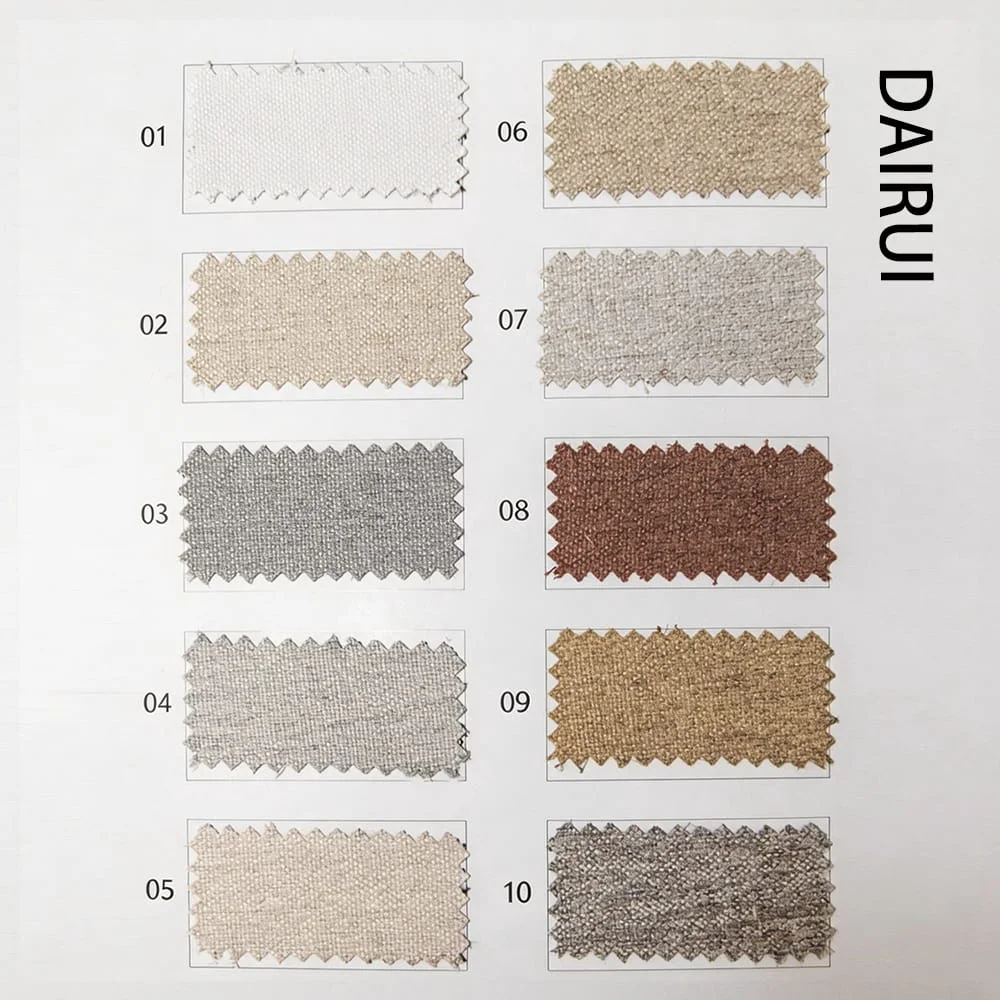
Linen-look — Polyester woven to imitate the slubs and texture of natural linen. It dominates wholesale curtain programs because it drapes like linen but washes, ships, and prices like polyester.
Velvet — A cut-pile fabric with a dense, plush face and heavy hand, often 260 GSM and up. Popular for hotel and luxury residential programs.
Coated blackout — A base cloth made opaque by acrylic or foam coating layers applied to the back. The most economical route to full blackout — compared in detail in our blackout construction guide.
Composite blackout — Two fabrics laminated around a TPU membrane or a coating layer. Face and back cloth can be specified separately, which is useful for hotel schemes that need a decorative face and a uniform white back.
Physical (woven) blackout — Blackout achieved by weave density alone — no coating or membrane. It feels the most like a normal decorative fabric and is the premium option of the three constructions.
TPU lamination — Bonding a thermoplastic polyurethane film between fabric layers. Delivers 100% opacity and a waterproof barrier while staying PVC-free.
Lining — A second fabric hung or sewn behind the face fabric — standard, dimout, blackout, or thermal. Our curtain lining types guide covers when each one earns its cost.
Interlining — A soft padding layer, often flannel, sandwiched between face fabric and lining. Adds insulation and a fuller, more tailored drape.
Dye lot — One batch of fabric dyed together. Shade can shift slightly between lots, so all panels for one project should be cut from a single lot.
Pattern repeat — The vertical or horizontal distance before a woven or printed motif repeats. Large repeats increase fabric waste because adjacent panels must pattern-match.
Railroading — Turning the fabric sideways so the roll width runs along the curtain width. With 280 cm+ wide fabric this yields seamless panels for wide windows.
Sourcing fabric by the roll rather than finished curtains? Our curtain fabric wholesale page covers widths, dye MOQs, and roll pricing separately.
Light Control & Performance Terms
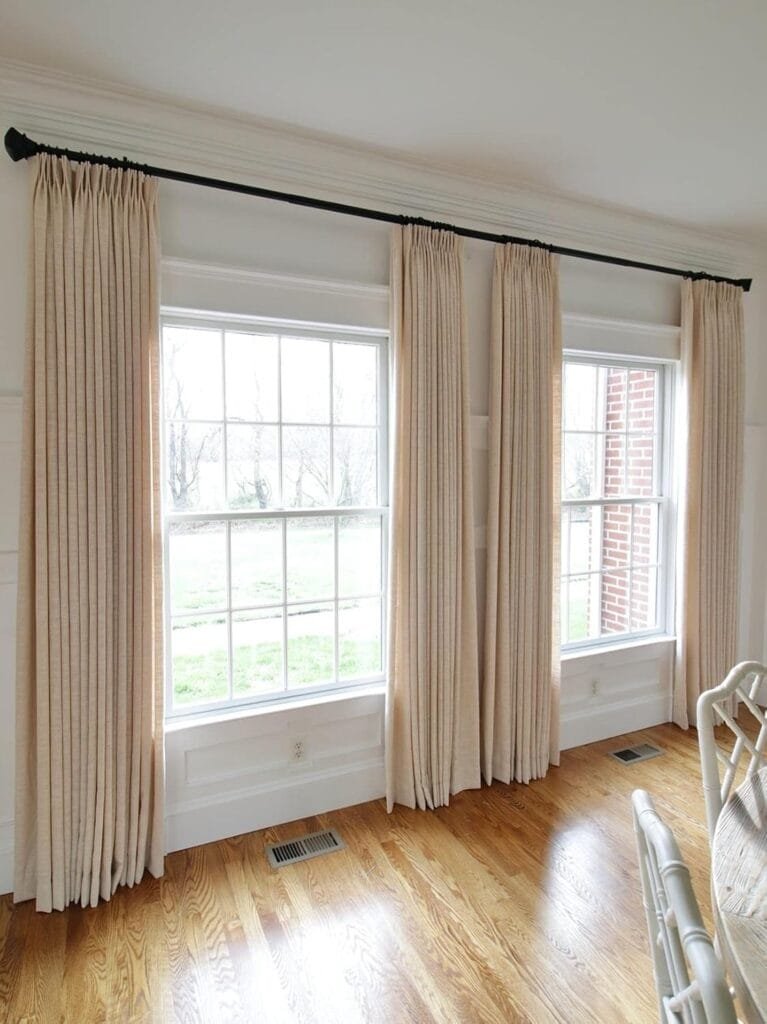
Blackout — Blocks effectively 100% of incoming light. Achieved through coated, composite, or high-density woven construction at 180–400 GSM — the construction, not the color, is what blocks light.
Room darkening — The band below full blackout: roughly 70–90% light blockage. Enough for living areas and most retail programs at a lower price point.
Dimout — The trade term for that same 70–90% band, common in hotel and contract specifications. The differences are unpacked in our dimout vs blackout guide.
Thermal curtain — Constructions that reduce heat transfer through the window — via coatings, linings, or interlining. A performance claim about insulation, not light.
UV resistance — The ability of a fabric to resist fading and fiber degradation in strong sun. A key line item for Australian, Middle Eastern, and southern-US orders.
FR-treated — Flame-retardant chemistry applied to the fabric after weaving. Effective and economical, but retardancy can diminish with repeated commercial laundering — see FR-treated vs inherently FR.
Inherently FR — Flame retardancy built into the polymer of the fiber itself (for example FR polyester). It survives washing for the life of the fabric and is the safer spec for hotels.
FR standards (NFPA 701 / BS 5867 / CAN/ULC-S109 / AS 1530) — The national flammability tests named in contract specs — NFPA 701 in the US, BS 5867 in the UK, CAN/ULC-S109 in Canada, AS 1530 in Australia. Contract orders are produced to meet the named standard, with test reports arranged per order.
OEKO-TEX Standard 100 — A substance-safety certification held at fabric-supplier level, confirming the cloth is tested for harmful substances. Wholesale buyers can request supplier-authorized certificates and test documentation.
Heading & Hardware Terms
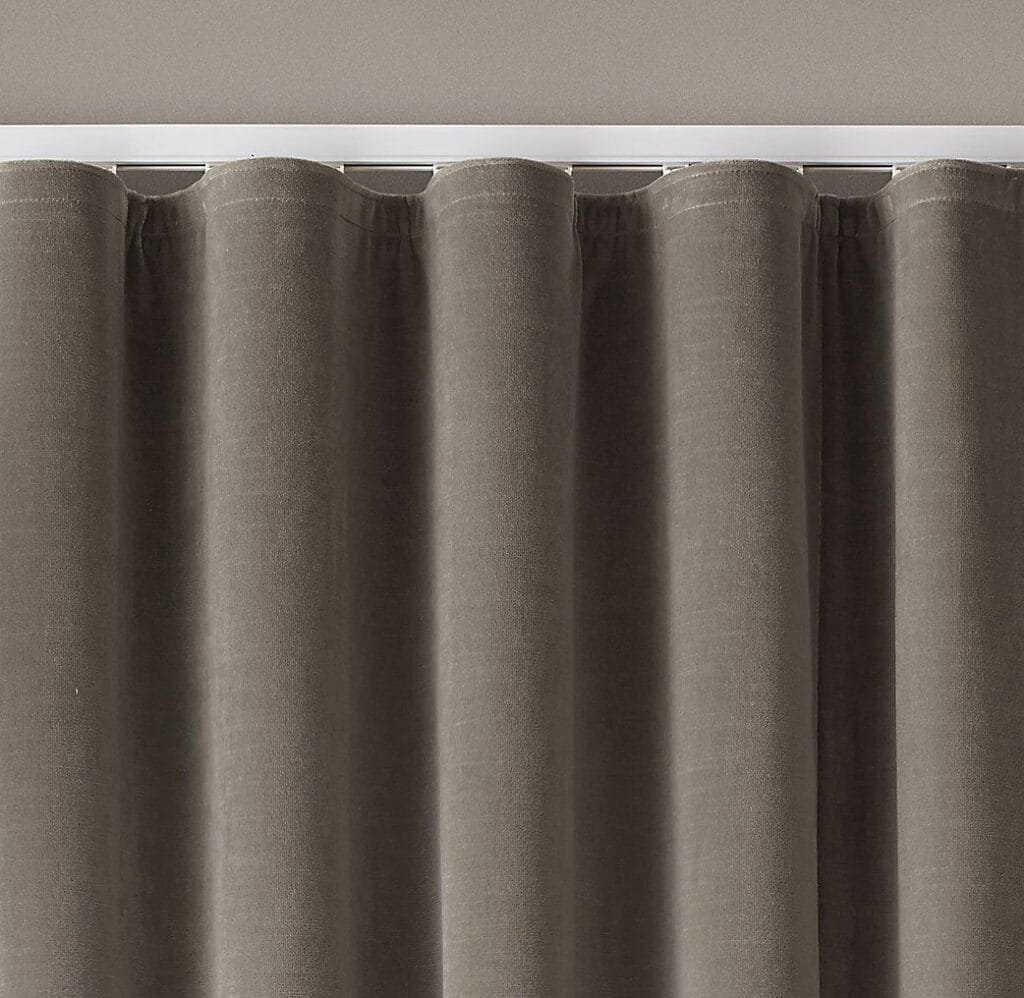
Heading (header) — The finished top of the panel. It decides how the curtain hangs, how much fabric it consumes, and what hardware it needs — the single biggest style decision in a program. Full comparison in our curtain heading styles guide.
Curtain track — The rail the panels run on: straight, curved, telescopic, hidden, or motorized. The track fixes the carrier spacing, so it constrains which heading you can use — specify it before the heading, not after. See our wholesale curtain track range.
Carrier (glider / runner) — The small wheeled or snap fitting that connects a panel to the track. Ripplefold and S-Fold use different carrier spacing and are not interchangeable, which is why the track decides the heading.
Master carrier — The lead carrier at the opening edge that pulls the panel when the curtain is drawn. On a centre-open pair it is the overlapping pair that closes the light gap in the middle.
Grommet (eyelet) — Metal rings punched through the header so the panel slides directly on a rod. The workhorse heading of North American retail.
Pinch pleat — Fabric gathered and sewn into permanent two- or three-finger pleats, hung on hooks or rings. The classic tailored look.
Pencil pleat — Tight, thin gathers formed by pulling the cords of a header tape. The default heading in UK and Australian retail.
Header tape — The sewn-in tape containing cords and hook pockets that creates pencil pleat and other tape-gathered headings.
Tab top — Flat fabric loops sewn to the top of the panel that slide over the rod. Casual look, no hardware beyond a rod.
Back tab — Hidden loops sewn on the back of the header, so the face shows a clean, uninterrupted line.
Rod pocket — A sewn channel the rod threads through. The simplest and cheapest heading to produce.
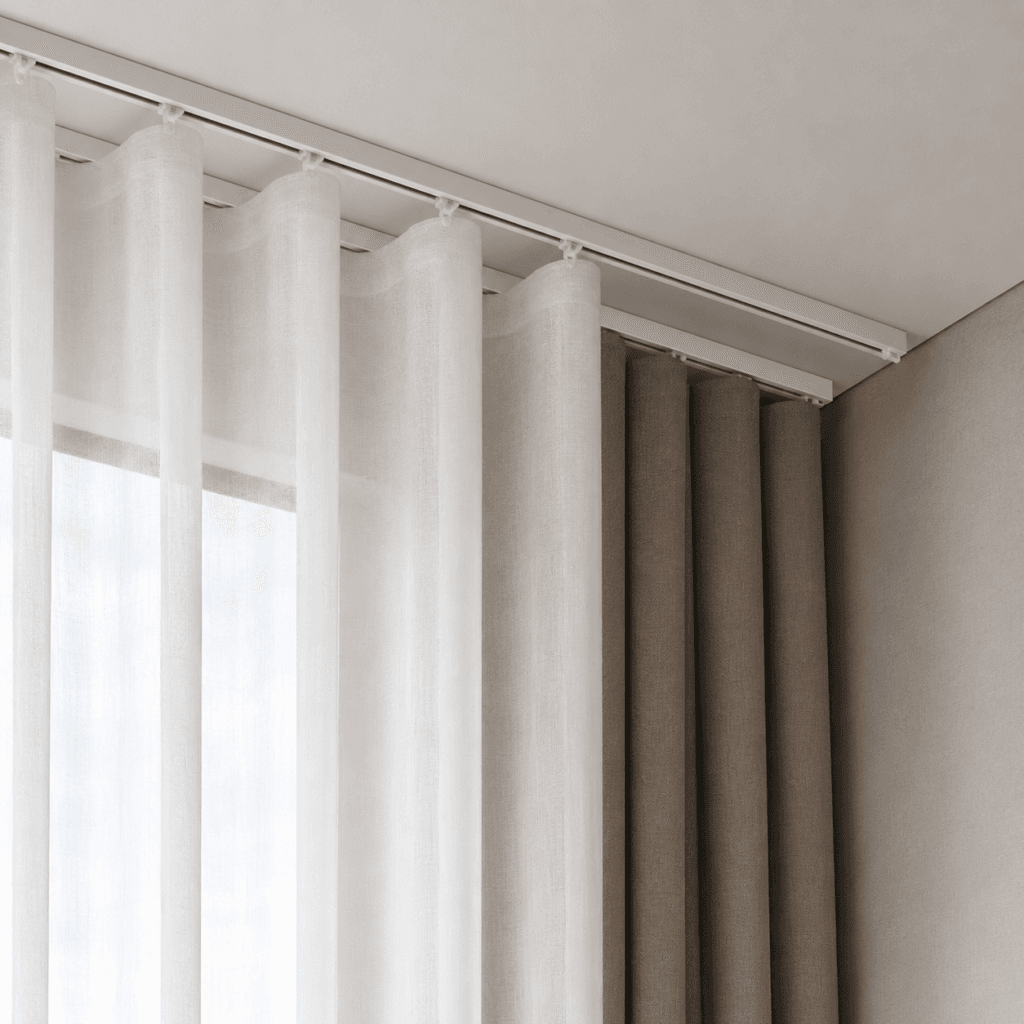
Wave — Soft, continuous S-curves formed by wave tape running on a glider track. The current premium look in Australian and European projects.
Ripplefold — The North American contract version of the wave: snap tape on a channel track, standard in hotels and offices.
Fullness ratio — Fabric width divided by track width. 1.5x reads economy, 2x standard, 2.5–3x luxury — and it is the biggest hidden driver of cost per window.
Drop — The finished curtain length, measured from the top of the heading to the hem.
Panel / pair — Curtains are quoted per panel (one width of finished curtain) or per pair. Always confirm which unit a price refers to.
Weighted hem — Weights sewn into the bottom hem so panels hang dead straight — why they matter is covered in our drapery weights guide.
Valance — A short decorative panel across the top of the window, often paired with main curtains in traditional schemes.
Tieback — The fabric band, cord, or holdback that keeps a curtain gathered open.
Manufacturing & Customization Terms
OEM (Original Equipment Manufacturing) — The factory produces to your design, specification, and brand. You own the design; the factory executes it.
ODM (Original Design Manufacturing) — The factory supplies its existing designs and you sell them under your own label. Faster to launch, no design cost.
Private label — A full OEM/ODM program where goods leave the factory retail-ready in your branding — sewn-in labels, inserts, and packaging. See our private label manufacturing page for how programs are structured.
CMT (Cut, Make, Trim) — A pricing model where the buyer supplies the fabric and the factory charges only for cutting, sewing, and finishing.
Lab dip — A small swatch dyed to match your target color, submitted for approval before bulk dyeing. Approve in the light source your market uses.
Strike-off — The print equivalent of a lab dip: a short pre-production print run to approve pattern, scale, and color.
PP sample (pre-production / counter sample) — The physical sample both sides sign off before bulk cutting. Bulk production is judged against it — keep one sealed set on each side.
Heat setting — High-temperature finishing that stabilizes polyester fabric so hems stay flat and the drape stays uniform panel after panel. Also called high-temperature shaping.
Tolerance — The agreed acceptable deviation on finished dimensions, typically ±1–2 cm on width and drop. Put it in writing before production, not after inspection.
Quality Control & Compliance Terms
AQL (Acceptance Quality Limit) — The statistical sampling standard used in inspections. AQL 2.5 for major defects is the common benchmark for curtain orders — our pre-shipment inspection guide walks through a real checklist.
PSI (pre-shipment inspection) — Inspection of finished, packed goods before the container is loaded — your last chance to catch problems while they are still the factory’s problem.
Third-party inspection — SGS, Intertek, TÜV, or a similar firm inspecting on your behalf, typically charged per man-day.
Colorfastness — How well dyed fabric resists fading from light, washing, and rubbing, graded 1–5. Contract specs usually demand grade 4 or better.
Shrinkage — The percentage a fabric contracts after washing. Curtain specs usually cap it around 3%; heat setting is what keeps polyester near zero.
BSCI — A social-compliance audit of factory working conditions. Buyers can request supplier-authorized audit documentation as part of vendor onboarding.
GRS (Global Recycled Standard) — Chain-of-custody certification for recycled-content fabrics such as RPET, verifying the recycled claim from flake to finished cloth.
Care label — The sewn-in washing instructions. Content, symbols, and language are regulated by the importing country — specify them in the tech pack.
Trade & Logistics Terms
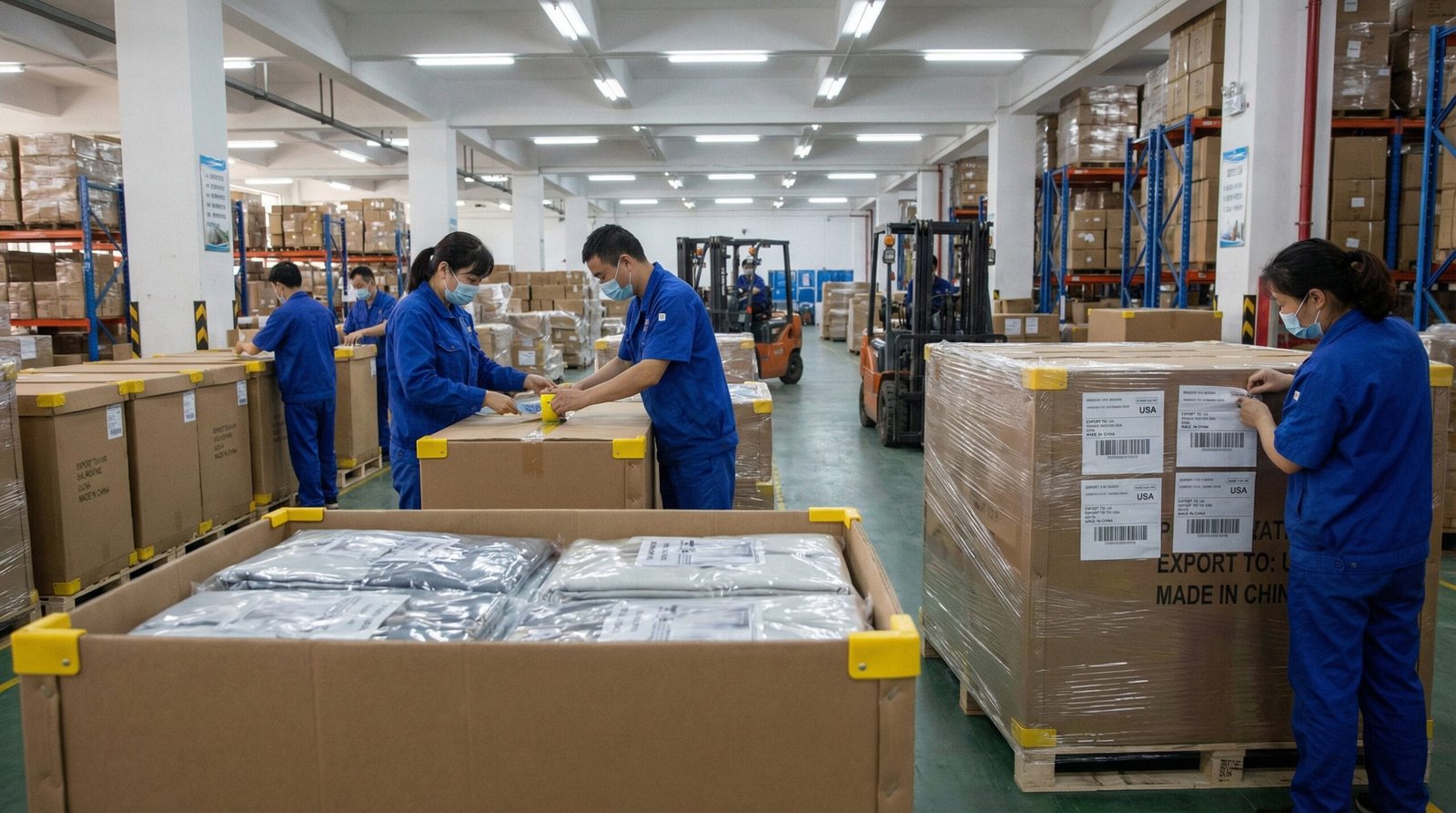
MOQ (minimum order quantity) — The smallest order a factory will run, commonly 100–500 panels per style/color for wholesale curtains (actual MOQ subject to quotation). Mixing SKUs and colors to reach it is often negotiable — see how buyers mix SKUs to hit MOQ.
EXW (Ex Works) — You collect at the factory gate and handle everything from there. Cheapest unit price, most responsibility.
FOB (Free On Board) — The factory delivers goods loaded on the vessel at the named Chinese port (for us, usually Ningbo); you pay freight onward. The default term for experienced importers — full comparison in our Incoterms guide.
CIF (Cost, Insurance, Freight) — The seller adds ocean freight and minimum insurance to your destination port. You still handle customs clearance and inland delivery.
DDP (Delivered Duty Paid) — The seller delivers duty-paid to your door. The simplest option for first-time importers, and the priciest per unit.
HS code — The customs classification that decides your duty rate; most finished curtains fall under heading 6303. Rates by country are in our import duties and HS codes guide.
PI (proforma invoice) — The quotation-contract hybrid confirming specifications, quantities, unit prices, and payment terms. Wire the deposit only after every spec on the PI is right.
T/T (telegraphic transfer) — A bank wire. The standard structure in the curtain trade is 30% deposit, 70% balance against shipping documents.
L/C (letter of credit) — Bank-guaranteed payment released against documents, used on larger contract orders where neither side wants open exposure.
Lead time — Production time after sample approval — around 30 days for standard bulk orders; complex custom programs can run longer. Sea freight is additional (roughly 15–25 days to the US West Coast or Australia, 30–40 to the US East Coast or Europe).
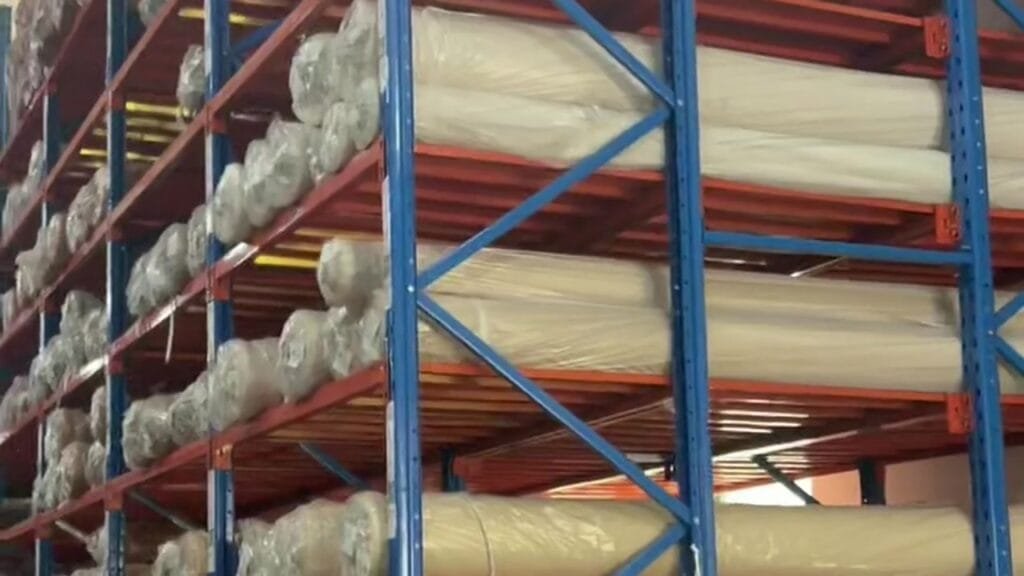
CBM (cubic meter) — The volume unit ocean freight is quoted on. Compressed packing meaningfully cuts CBM — and your freight bill.
20GP / 40HQ — The standard 20-foot container (~28 CBM) and 40-foot high-cube (~68 CBM). Quoting a full container usually unlocks better unit pricing.
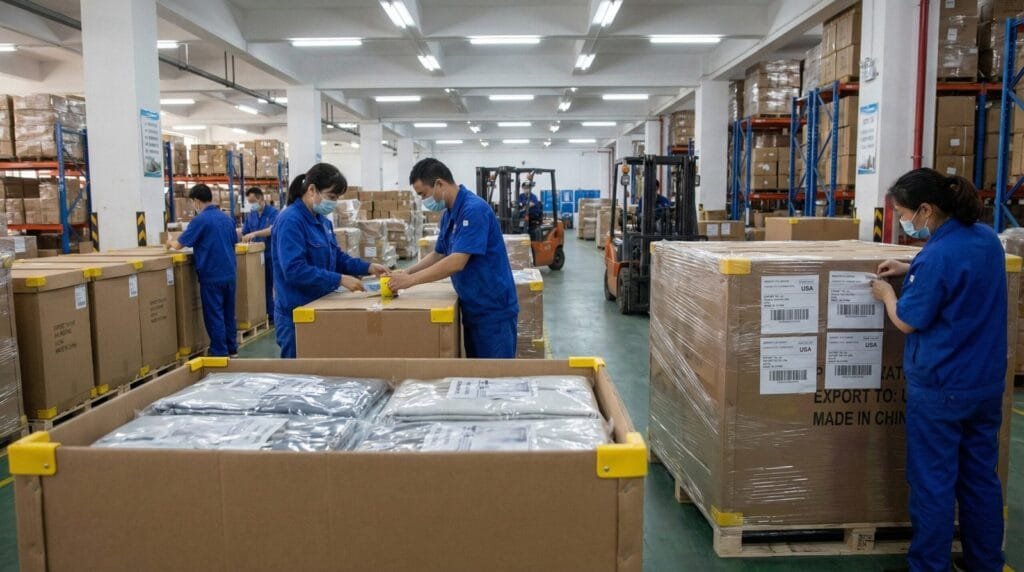
Freight forwarder — The agent who books ocean or air freight, prepares export documents, and coordinates between factory, carrier, and customs broker.
FAQ: Curtain Sourcing Terms
What does GSM mean when sourcing curtains?
GSM is grams per square meter, the weight of the fabric. Sheers run 60–90 GSM, standard decorative fabrics 120–160 GSM, and blackout constructions 180–400 GSM. Heavier fabric generally means better drape and opacity but higher fabric and freight cost.
What is the difference between OEM and ODM in curtain manufacturing?
With OEM the factory produces to your own design and specification under your brand. With ODM you select from the factory’s existing designs and sell them under your label. ODM is faster and has no design cost; OEM gives you a product competitors cannot copy from a catalog.
What is a typical MOQ for wholesale curtains?
Most factories quote 100–500 panels per style and color, with the exact figure subject to quotation. Many, including Dairui, allow mixing SKUs and colors to reach the total, which lets smaller brands test several designs in one order.
What does AQL 2.5 mean in a curtain inspection?
AQL 2.5 is the acceptance quality limit for major defects under standard sampling rules. The inspector pulls a statistically defined sample from the packed order; if major defects exceed the AQL 2.5 threshold for that sample size, the batch fails and must be reworked before shipping.
Should a first-time curtain importer choose FOB, CIF, or DDP?
DDP is the simplest: the seller handles freight, customs, and duty, and you receive goods at your door for one landed price. It costs more per unit than FOB, where you arrange freight yourself. Most buyers start DDP or CIF and move to FOB once they have their own forwarder.
What is the difference between blackout and dimout curtains?
Blackout blocks effectively 100% of light using coated, composite, or high-density woven construction. Dimout — also sold as room darkening — blocks roughly 70–90%. Hotels often specify dimout for living spaces and full blackout for sleeping rooms.
Bottom Line
You do not need to memorize all 70 terms — but the ten that decide your money are GSM, blackout construction, heading, fullness ratio, MOQ, lab dip, PP sample, AQL, FOB/DDP, and lead time. Get those right in the proforma invoice and the rest of the order tends to follow. For the step-by-step process this vocabulary plugs into, start with our guide on how to source curtains from China, or send us the spec you are working on and we will quote against it.
DAIRUI Sourcing Desk
Last reviewed: 2026-07